
 By Ishmael Junourgh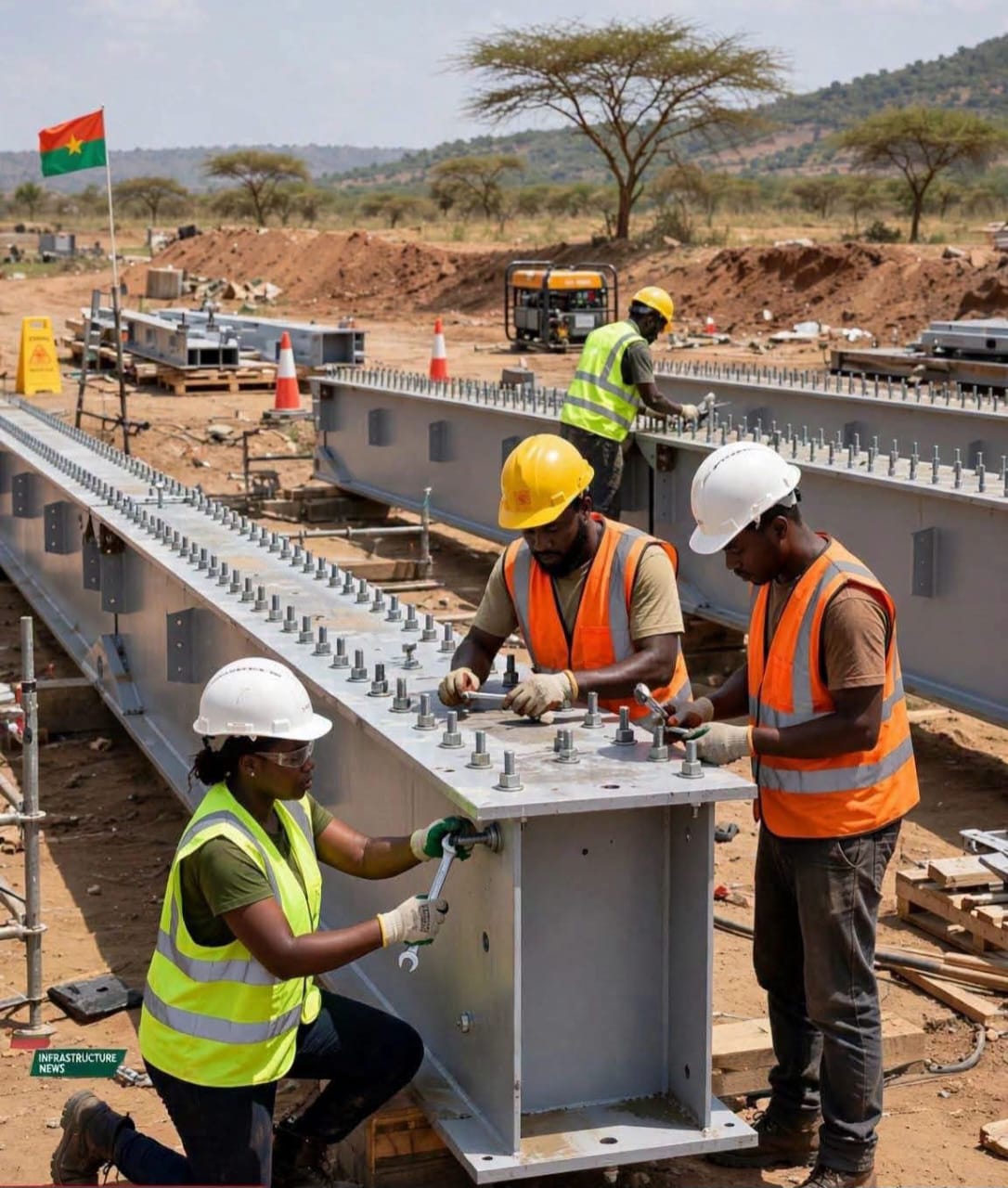
In a country where damaged roads and bridges can quickly isolate communities, disrupt trade and complicate humanitarian and security operations, Burkina Faso is turning to an increasingly important form of infrastructure resilience: bridges that can move when the roads cannot.
The West African country is training 120 Burkinabè technicians and personnel to deploy Unibridge mobile bridges, an initiative aimed at ensuring that the collapse or destruction of a critical crossing does not necessarily become a prolonged interruption to movement.
The trainees have been drawn from the Ministry of Construction, the military engineering corps and Faso Mêbo, a national initiative involved in infrastructure development. Their training covers the practical skills required to assemble, dismantle, maintain and operationally deploy the mobile bridge systems.
The significance goes beyond the technology itself.
For Burkina Faso, the initiative represents an effort to build domestic technical capacity capable of responding to infrastructure emergencies without having to depend entirely on external expertise.
When a bridge goes down, connectivity can disappear
Across Africa, bridges are more than concrete and steel structures. They are lifelines connecting farming communities to markets, patients to health facilities, children to schools and regions to national economies.
When a major bridge is washed away, damaged or rendered unusable, the consequences can extend far beyond the immediate physical destruction.
Transport costs rise. Agricultural produce can spoil. Emergency services face delays. Commercial activity slows. In remote areas, communities can effectively become isolated.
Mobile bridging technology offers a different proposition: restore connectivity first, rebuild permanently later.
Rather than waiting months for conventional reconstruction, trained teams can establish a temporary crossing to restore circulation while longer-term engineering works are undertaken.
Burkina Faso bets on skills, not only equipment
During a visit to the National School of Public Works, Construction Minister Mikaïlou Sidibé underscored the importance of transferring the knowledge required to operate and maintain the technology to Burkinabè personnel.
That emphasis is critical.
Infrastructure resilience is not created simply by purchasing sophisticated equipment. It depends on whether a country has the engineers, technicians and institutions capable of deploying, maintaining and adapting that equipment when an emergency occurs.
By training personnel from civilian construction institutions, military engineers and Faso Mêbo, Burkina Faso is effectively creating a pool of specialists who can potentially respond across different operational environments.
The approach also brings together capabilities that are often treated separately: civil engineering, military engineering and national infrastructure mobilisation.
A bridge for emergencies; and a broader development strategy
The mobile bridge programme arrives at a time when Burkina Faso is seeking to strengthen its ability to maintain essential infrastructure amid significant pressures on the country’s transport networks.
Its value, therefore, may extend beyond disaster response.
A mobile bridge can potentially become an instrument of economic continuity; allowing trucks, buses, farmers, traders and emergency vehicles to continue moving even when permanent infrastructure has been compromised.
For landlocked Burkina Faso, where road connectivity is central to domestic commerce and access to neighbouring markets, that resilience carries strategic importance.
The initiative also reflects a broader question confronting African countries: How much of the continent’s infrastructure resilience can be built from within?
For decades, major infrastructure projects across Africa have often relied heavily on foreign contractors, imported technology and external technical expertise. Burkina Faso’s decision to invest in specialised domestic training points towards a different model; one in which technology is acquired, but the knowledge to operate it is deliberately retained and developed locally.
The bigger lesson for Africa
The real test will come when the technology is needed in an actual emergency.
A mobile bridge sitting in storage is only equipment. A trained team capable of transporting it to a damaged crossing, assembling it safely and restoring traffic within a short period is a national resilience asset.
That distinction is at the heart of Burkina Faso’s initiative.
The training of 120 personnel may therefore appear modest against the scale of the country’s infrastructure needs, but it represents an important principle: resilient infrastructure is not only about building stronger roads and bridges; it is also about building the human capacity to keep societies connected when those structures fail.
As climate-related extreme weather, conflict, ageing infrastructure and rapid urbanisation increasingly test transport networks across Africa, the ability to restore connectivity quickly could become just as important as the ability to construct permanent infrastructure.
For Burkina Faso, the mobile bridge is consequently more than a temporary crossing. It is a statement of preparedness — and an investment in the idea that when a road ends unexpectedly, the country’s ability to keep moving should not end with it.