
 By Zakaria Rafique Seinu
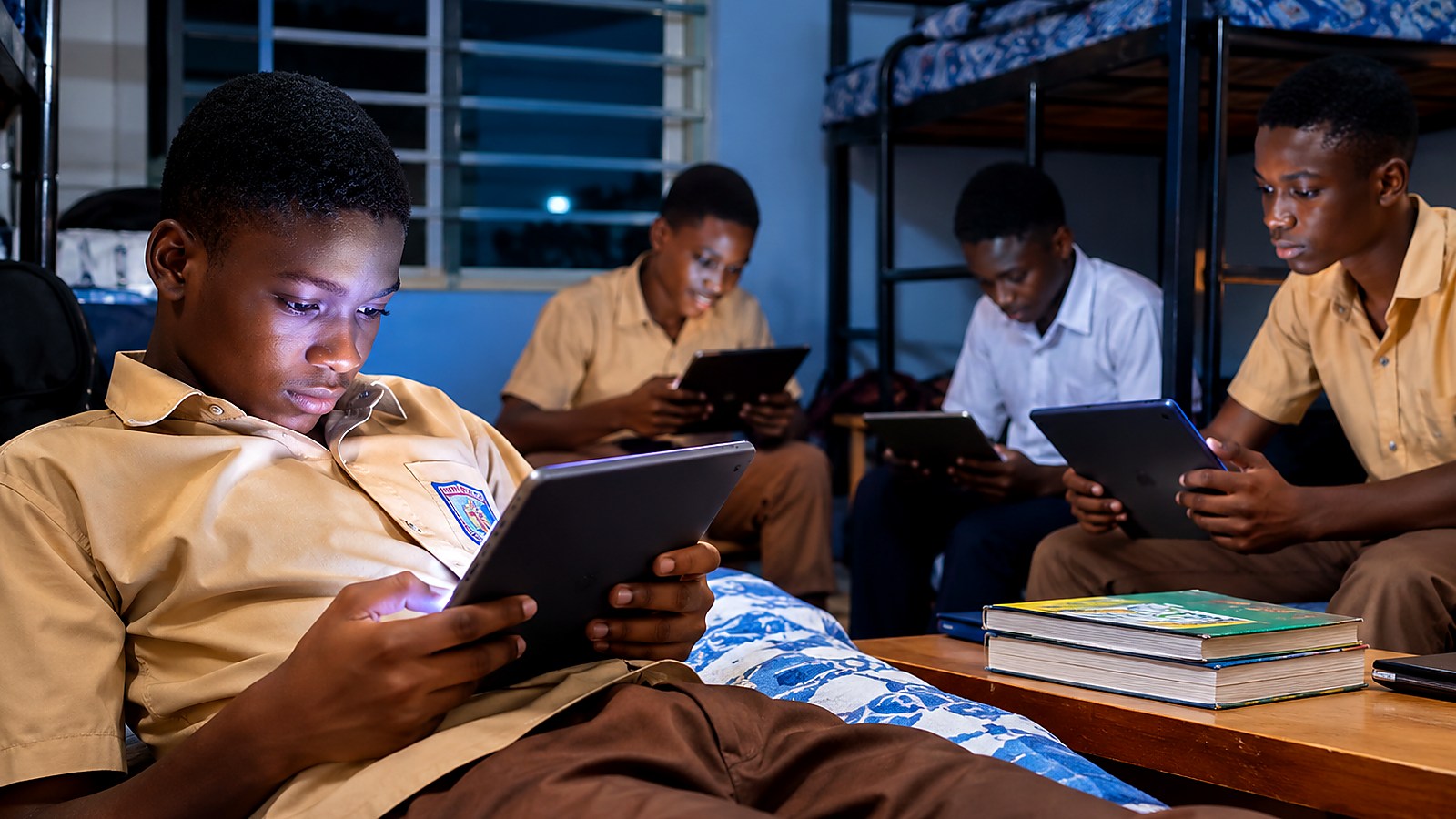
At 1:47 a.m. on a school night in a boys’ dormitory in the Upper West Region, the lights are off. The housemaster has done his rounds. The school is quiet.
But under the blankets, it is not quiet. Small screens glow. Fingers move quickly. A boy is watching a football highlight. Another is chatting with a girl in another school. Another is deep inside a game he started at 9 p.m. and cannot stop. Another is watching something he would never dare to watch in the daytime, with the volume low and his heart beating fast.
At 6 a.m., the bell will ring. At 8 a.m., they will be in class. Their bodies will be present. Their minds will still be asleep.
This is the new reality of Senior High School education in Ghana.
The modern SHS student in Ghana is well informed. He is shaped by what he sees and hears. He does not wait for the teacher to tell him what is happening in the world. He has already seen it on his screen before the teacher enters the classroom.
The distribution of tablets to students was meant to close the gap between the rich and the poor, between the city school and the village school, between Ghana and the rest of the world. It was a bold, progressive idea. In principle, it was right. In practice, it has exposed our students to a lot of things we did not prepare them for.
The 21st century student cannot be taken for granted. He wants to assert his rights. She wants to assert her rights. And they should. A student who knows his rights is not a problem. He is a citizen in training.
But rights without responsibility, information without guidance, and access without discipline create a dangerous mixture. That is what we are now witnessing in many of our schools.
The tablet is a weapon in the hands of our students. And like every weapon, it can be used for good or for bad.
In the hands of a focused student, the tablet is a miracle. It is a library that never closes. A student in Jirapa can now watch the same science experiment as a student in Achimota. A student in Bawku can download past WASSCE questions without waiting for a teacher to photocopy them. A student who does not understand a topic in class can watch a teacher on YouTube explain it again, slowly, in a different way, until it makes sense.
I have spoken to students who have used the tablet well. One girl in the Upper West Region told me she learned French from an app on her tablet. A boy in Lawra told me he learned to code. A teacher in Wa told me his students now ask deeper questions because they have read ahead.
That is the good side. That is what the policy intended.
But there is another side, and any honest journalist, teacher, or parent who visits our schools will tell you the same story. The same tablet that teaches can also distract. The same tablet that opens the mind can also corrupt it.
Once these tablets are given, students need electricity to charge them when the battery is down. That sounds like a small technical detail. In our schools, it is a daily crisis.
Many SHS campuses in the Upper West Region were not built for 1,000 tablets. They were built for lights in the classroom, a fan in the dormitory, and a socket in the staff room. Now, every student is looking for a socket. Students queue for plugs. Students fight over plugs. Students hide their chargers. Students pay seniors to charge for them. Students charge in forbidden places, overloading sockets and creating a real fire risk.
In some schools in the Upper West Region, teachers tell me students now bring extension boards to school like market women. In others, students sneak to the dining hall at midnight just to charge. Electricity, which should be a basic facility, has become a source of quarrel, cheating, and indiscipline.
We gave the students the device before we gave the schools the power to support it. That is like giving a farmer a tractor without fuel.
The second challenge is even more visible: students now play games and study less.
Let us be honest. The game is designed to be addictive. It is colourful. It rewards you. It makes you feel like a winner. A mathematics formula does not do that. A chemistry equation does not clap for you. The game does.
Many students start with good intentions. They open the e-book. They read for five minutes. Then a notification comes. A friend has invited them to a game. A new video has dropped. An hour passes. Two hours pass. Midnight comes. The book is still on page one.
Teachers across the Upper West Region are reporting the same thing: attention span is dropping. Students who used to read for two hours can now barely read for twenty minutes without checking their tablet. The tablet has trained them to want quick entertainment, not slow learning.
This is not because our students are lazy. It is because they are young. A 15-year-old, a 16-year-old, left alone in a dormitory with a device designed by the best engineers in the world to keep him hooked, will struggle. Without rules, he will lose.
The third challenge is the most sensitive, but we must discuss it if we want to educate and not just pretend. The tendency for students to be exposed to nude content and to explore drugs is high.
The tablet has no gatekeeper. Once a student is connected to the internet, he is connected to everything. With one search, a student can find explicit content that his parents have tried to protect him from for sixteen years. With one click, he can find videos that glorify drug use, that make smoking look cool, that make drinking look like freedom.
In the old days, to see such things, a student had to go to town, hide, and pay. Today, such things come to the student in his bed, under his blanket, for free, at 2 a.m.
Parents often ask me, “Will my child look?” The honest answer is: curiosity is human. Teenage curiosity is especially strong. The question is not whether they will be tempted. The question is whether we have prepared them to say no, to close the page, to report, to understand the consequences.
Currently, many schools in the Upper West Region have no filtering system. Many tablets have no parental controls. Many students have no digital literacy training. We have given them access without teaching them self-control.
Closely linked to this is the fourth challenge: students can now call on persons from outside who influence them into bad habits.
Before the tablet, the school was a closed world. The gate was locked. The housemaster checked who came in. A stranger could not easily enter to spoil a student.
Now, the stranger does not need to pass through the gate. He enters through the screen. He is a WhatsApp contact. He is a Facebook friend. He is a TikTok lover. He is a “big boy” in Accra who promises a girl money, a phone, and a better life if she runs away. He is a dealer who promises a boy quick money if he brings other boys into the trade.
The student may be physically in school, but mentally, he is outside. He is taking instructions from someone who has never set foot in the school compound. That person can tell him to insult a teacher, to steal, to break bounds, to join a group. And because the student trusts the voice on the phone more than the voice of his teacher, he obeys.
Teachers in the Upper West Region tell me of cases where students have been lured out of school by people they met online. Girls have been lured into relationships. Boys have been lured into fraud and petty crime. The school authorities only find out when it is too late.
The fifth challenge is economic, and it is driving a new wave of indiscipline: theft is likely to be on the rise since students will need to buy data.
A tablet without data is like a car without fuel. It cannot move. To make it work, the student needs data. Data costs money. Many parents in the Upper West Region cannot afford to send money every week for data. Many students have no money at all.
What does a desperate student do? The evidence from schools is worrying. Students steal from their mates’ chop boxes. Students steal phones to sell them. Students steal tablets and sell them cheaply to buy data for their own tablets. Students lie to their parents that the school is demanding money for a project, and use that money for data.
We have created a new need without creating a new source of income to meet that need. When need meets poverty, theft is born. The school that used to fight against the stealing of gari and shito must now fight against the stealing of tablets, chargers, and data money.
The sixth challenge is organisational: students can form social networks that can enable them to plan against school authorities without their notice.
In the past, if students wanted to plan a riot, they had to whisper in the dormitory. The housemaster could hear them. The senior prefect could report them. Planning was slow and risky.
Now, planning is fast and secret. Students can create a WhatsApp group with 200 members in five minutes. They can create a group with no teacher inside. They can plan a boycott of classes. They can plan to attack a teacher they dislike. They can plan to destroy school property. And the authorities will know nothing until it has happened.
The tablet has given students a secret parliament. They can meet without meeting. They can talk without talking. They can organise without gathering. This is power. And power without maturity is dangerous. Several recent disturbances in SHS schools in the Upper West Region, according to headteachers I spoke to, were not spontaneous. They were coordinated on phones.
The final challenge is the most visible in the classroom: students stay all night on their phones and may be seen sleeping in class in daytime when lessons are ongoing.
Go to any SHS in the Upper West Region today and you will see it. The teacher is teaching. A student is sleeping with his eyes open. He nods. He jerks. He sleeps again. When you wake him, he is angry. When you punish him, he says you are violating his rights.
We are producing a generation that is awake at night and asleep in the day. A generation that is tired, distracted, and unable to concentrate. How can such a generation pass WASSCE? How can such a generation build Ghana?
Let me be clear: this article is not a call to take the tablets away. That would be a mistake. The world has moved on. Ghana cannot move backwards. Our students must compete with students in Kenya, Nigeria, Singapore, and America. They need technology. Taking the tablets away would punish the good students because of the bad behaviour of some.
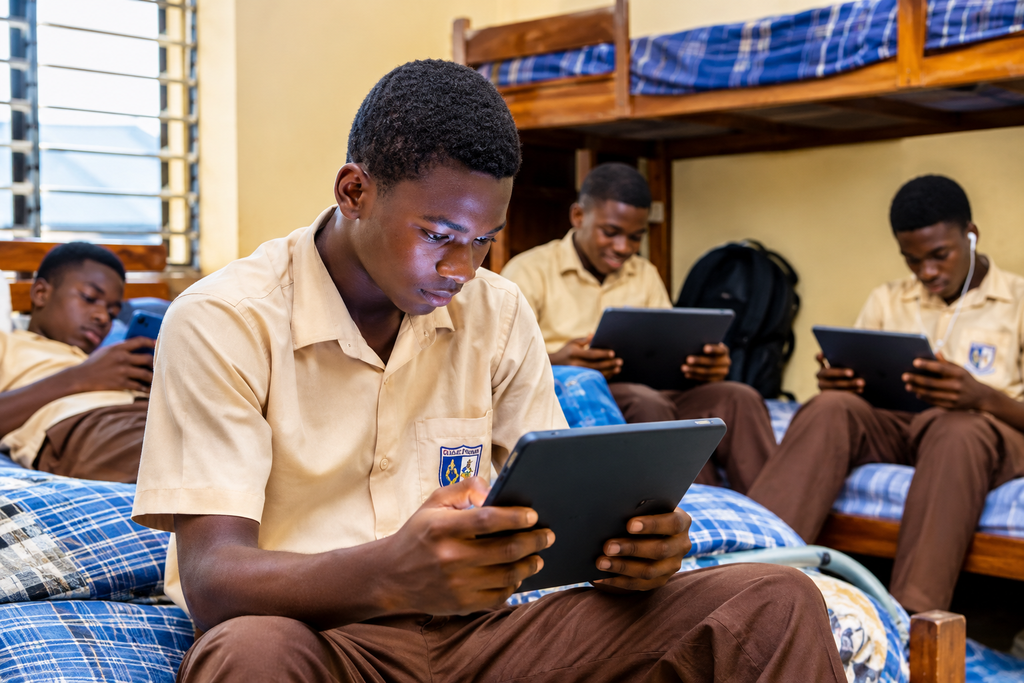
What we need is a review of the policy. Accessibility and quality should not be mistaken for laxity.
Giving every student a tablet is accessibility. Making sure the tablet helps the student to learn is quality. Allowing the student to use the tablet for anything, at any time, in any place, without control, is laxity. And laxity will destroy the very purpose of the tablet.
A realistic review must include five practical steps.
First, content control. Tablets used in schools should be configured to prioritise educational content during school hours. School Wi-Fi should block pornographic sites, gambling sites, and gaming sites. This is not censorship. This is protection. We do it in our homes. We must do it in our schools.
Second, power and charging. Every school in the Upper West Region that receives tablets must receive a proper charging station, supervised by teachers, with safe sockets and a timetable for charging. No student should have to fight for a plug at midnight.
Third, time discipline. Tablets should be collected at a certain time at night, for example 9 p.m., and returned in the morning. No student needs a tablet at 2 a.m. in the dormitory. Sleep is also part of education.
Fourth, data for learning. The government and schools should provide data for educational use, so students do not have to steal to buy data. If data is provided for learning, the excuse for stealing disappears.
Fifth, digital literacy and parental involvement. We must teach students not only how to use the tablet, but how to resist its temptations. How to recognise online predators. How to say no to nude content and drugs. How to manage time. Parents in the Upper West Region must also be involved, not just to celebrate that their child has a tablet, but to monitor what the child does with it.
The modern SHS student in Ghana is well informed. That is true. But being informed is not the same as being wise. Information without wisdom is like a fast car without brakes. It will crash.
The tablet has given our students speed. Now we must give them brakes. We must give them direction. We must give them discipline.
If we do that, the tablet will be what it was meant to be: a weapon for good, a tool for learning, a bridge to the future.
If we do not, the tablet will be what we fear: a weapon for distraction, a tool for destruction, a bridge to failure.
The choice is ours. And the time to make that choice is now, before another generation in the Upper West Region sleeps through its own future.
 Charles Prempeh PhD