
 By Charles Prempeh PhD
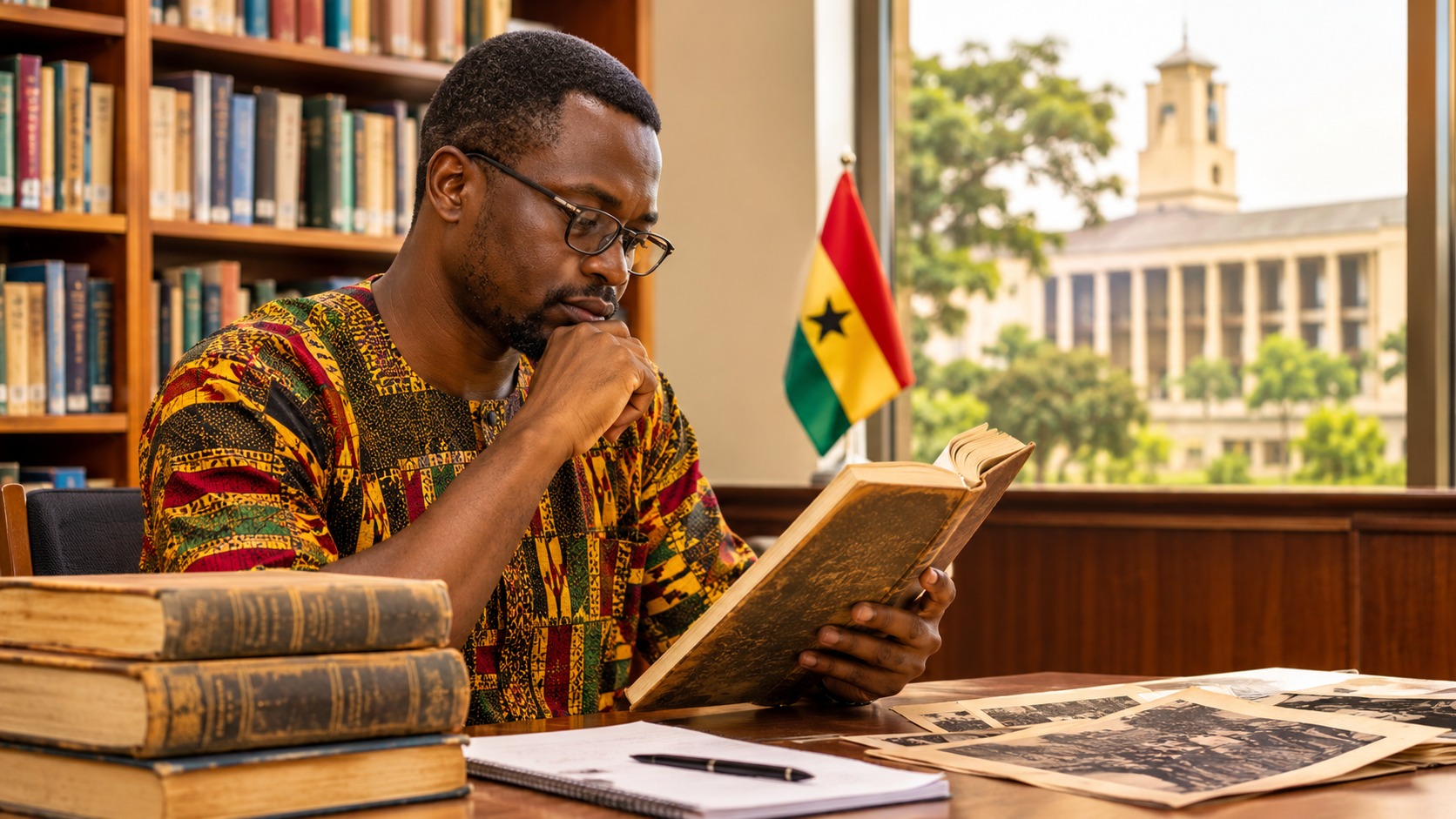
Every now and then, I sit in my corner at Baakingota, hemmed between Maa mo mo mli bii and Yan Nima, and pretend to understand the things that happen in Ghana. More importantly, I have often found myself reflecting on what it means to be Ghanaian through the prism of the autobiography of Joseph Appiah, popularly known as Joe Appiah. He was a fine gentleman, a lawyer, a remarkable friend of Kwame Nkrumah, and a voluble patriot. Indeed, he considered patriotism sufficiently important to make it part of the title of his autobiography.
Joe Appiah belonged to a generation of post-World War II nationalists who devoted their lives to the struggle for the independence of what is now known as Ghana. His political life, however, followed difficult and sometimes tragic trajectories, including multiple politically motivated incarcerations. Unlike several of his contemporaries, he was fortunate to live long enough to witness the changing fortunes of governance in Ghana. With the benefit of age, memory, and hindsight, he eventually wrote an autobiography that offers profound insights into the making of Ghana and, more importantly, the complicated question of what it means to be Ghanaian.
There is something particularly instructive about the manner in which Joe Appiah tells his story. He writes with the sensibilities of a sage and the discipline of a careful chronicler. His account of Ghana’s history offers perspectives that differ considerably from those found in several other autobiographical works. Beginning with his experiences of life in Asante, he provides an interesting account of a people who had historically resisted various forms of imperial domination. From there, he turns to the work of Christian missionaries and their establishment of educational institutions such as Mfantsipim, his alma mater, which is currently celebrating its 150th anniversary.
Unlike many reactionary academics who condemn the missionaries under the pretext of an epistemically disordered, intellectually mangled, nebulous, and often hysterical conception of decolonisation, Joe Appiah soberly acknowledges their contributions. He celebrates the dedication and selflessness with which nineteenth-century missionaries committed themselves to establishing educational institutions and laying important foundations for Ghana’s emergence as a modern postcolonial state. His account is a useful reminder that historical interpretation requires intellectual honesty, not ideological convenience. One cannot understand the making of modern Ghana by selectively remembering the past or by allowing contemporary ideological preoccupations to dictate historical judgment.
Joe Appiah, who, as I have already observed, lived longer than many of his contemporaries, had the benefit and burden of witnessing the contradictions of postcolonial Ghana. He had seen how several of the leaders who inherited the independence project gradually undermined the very vision upon which the struggle against colonialism was anchored. He had witnessed political vacillation, institutional decay, and the destructive consequences of personal rivalries. He had seen how envy, jealousy, malice, and viciousness had subverted the story that ought to have been told about the making of Ghana.
Those who dedicated their intellect to constructing an enduring philosophical architecture for nation-building were profiled as traitors and fifth columnists. Meanwhile, public intellectuals who chanted empty Marxist slogans were elevated to the status of political sages. In the process, the country gradually lost its appetite for a coherent intellectual history. Who, after all, cares about reading or rereading Ayi Kwei Armah’s *The Beautyful Ones Are Not Yet Born*? Who cares about the painstaking and objective study of history? Who is interested in understanding the intellectual traditions, philosophical disagreements, and political convictions that shaped the emergence of Ghana?
Perhaps we should not be surprised. We have increasingly surrendered the interpretation of our history to celebrities who jump from one house to another, presenting their figments of imagination as historical facts to the applause of a public that has suffered regrettable epistemic violence. The tragedy is not simply that false narratives circulate. It is that they increasingly acquire the authority of history, while rigorous scholarship is dismissed as inconvenient, elitist, or politically unhelpful.
Last Saturday, 7 November 2026, I attended a programme at the Great Hall of the Kwame Nkrumah University of Science and Technology. A former student leader took the stage to speak about a story that included aspects of Ghana’s political history. When he began with repeated expressions such as “so and so was there”, I immediately suspected that he had absorbed far too much of the rhetoric of a celebrated public intellectual. Expectedly, when he proceeded to offer his distorted understanding and interpretation of Ghana’s history, I bowed my head in shame.
I was very embarrassed. Here was a former student leader of the institution where I teach, standing in the hallowed halls of the Great Hall and mindlessly bastardising the history of the country. As I struggled to contain my embarrassment, a rather uncomfortable question confronted me: Am I part of this young man’s miseducation?
The question was particularly troubling because it forced me to reflect on the responsibility of the university as an institution of intellectual formation. I recalled how, in November 2025, I had joined a convocation ceremony at the same Great Hall to celebrate the graduands of KNUST. The juxtaposition of these two experiences was certainly not lost on me. What happens when our students make their debut into institutions of higher learning? And what happens when they eventually exit the Great Hall after graduation? What intellectual and historical sensibilities have they acquired in the intervening years? Who teaches them about Ghana’s history, and what exactly are they taught?
These questions are not abstract to me. I have had a few opportunities to teach a course on Africa’s Intellectual History to postgraduate students at KNUST. The course existed before I joined the university five years ago. However, about three years ago, I was asked to take responsibility for teaching it. When I assumed that responsibility, I had good reason to redesign the entire course. I considered it important that students should encounter the intellectual traditions, philosophical disagreements, historical personalities, and competing visions that have shaped Africa’s political and intellectual development.
Graciously, my students responded positively. One of them, a brother from the University of Cape Coast, my undergraduate alma mater, expressed exceptional gratitude for having registered for the course. I had the opportunity to teach it again to another group of postgraduate students during the 2025/2026 academic year. Once again, my students, including a Ghanaian based in the United States, expressed gratitude for having taken the course.
These experiences have reinforced my conviction that intellectual formation is indispensable to nation-building. A university should be more than a place where students acquire certificates and prepare themselves for the labour market. It must be an institution where they encounter ideas, interrogate received wisdom, develop historical consciousness, and cultivate the intellectual independence necessary for responsible citizenship. A university that fails in this responsibility risks producing graduates who possess academic qualifications but remain intellectually vulnerable to the manipulations of public discourse.
The tapestry of Ghana’s political history reveals several fault lines, all of which converge on a nagging paradox. As a people, we profess to desire individuals who are honest, dedicated, industrious, patriotic, truthful, intelligent, and genuinely committed to the project of nation-building. Yet, at a fundamental level, we seem unwilling to accommodate the very individuals who embody these virtues.
The reason is not difficult to discern. A hardworking person exposes our laziness. A truthful person unveils our penchant for lies. An intelligent and intellectually disciplined person exposes the superficiality of our political conversations and the inadequacies of our conception of the modern state. A genuinely patriotic person challenges the transactional understanding of citizenship that has become so deeply embedded in our political culture.
We therefore find ways of resolving the contradictions of our inherent hypocrisy. First, we celebrate dedicated individuals when they are dead and properly buried. After all, the dead pose no threat to anyone. Their convictions can be conveniently appropriated, their sacrifices selectively remembered, and their intellectual contributions celebrated without the inconvenience of having to accommodate their presence or challenge their ideas while they are alive.
Second, we deliberately exaggerate the stories of selected individuals to overshadow those who dedicated their lives, often at enormous personal cost, to building Ghana. We maliciously profile some of these individuals, much like giving a dog a bad name to have it hanged. In this manner, we manufacture national heroes, manufacture national villains, and gradually lose the capacity to distinguish historical merit from political convenience.
It is against this background that Joe Appiah’s reflections on a particularly difficult question become instructive. He dedicated a portion of his autobiography to responding to the question: Is Ghana worth dying for?
After a penetrating historical and philosophical examination of great leaders of the world, including Jesus Christ, my Lord and Saviour, Appiah arrived at a rather uncomfortable conclusion: Ghana was not worth dying for. Instead, a conscious individual ought, while alive, to think about his faith, family, and friends.
There is something profoundly unsettling about this conclusion, particularly when considered against the sacrifices of the generation that struggled for Ghana’s independence. Yet, perhaps its significance lies precisely in the uncomfortable questions it raises about the relationship between patriotism, political authority, personal responsibility, and the value of human life. What does it mean to love a country that repeatedly betrays the ideals upon which it was founded? What obligations does a citizen owe a state that has failed to demonstrate a corresponding commitment to the dignity and welfare of its people? Is patriotism an unconditional surrender of the individual to the political machinery of the state?
Having reflected on the state of public education in Ghana today, as well as the recent controversy surrounding money and Ghana’s heritage, I find myself increasingly sympathetic to Joe Appiah’s conclusion. I also find considerable wisdom in the Catholic theological principle of subsidiarity, which should guide everyone who makes the pilgrimage through life. The principle reminds us that responsibilities ought to be discharged at the appropriate levels of human association, beginning with the individual, the family, and other immediate institutions of social life. It cautions against the excessive concentration of authority in the state and the tendency to surrender responsibilities that properly belong to individuals and smaller communities.
We cannot construct a meaningful national identity by celebrating convenient historical narratives while deliberately suppressing uncomfortable truths. A country that cannot tell its own story honestly will struggle to understand its present, let alone imagine a coherent future.
The story we tell as a nation matters. It determines whom we celebrate, whom we condemn, what we remember, and what we eventually become. More importantly, it reveals the kind of people we are prepared to accommodate and the kind of society we are willing to build.
Nation-building is a philosophical project. It demands intellectual honesty, historical consciousness, institutional responsibility, and a willingness to confront uncomfortable truths. It should never be supplanted by populism and public intellectualism.
Satyagraha
 Zakaria Rafique Seinu