
 By Ishmael Junourgh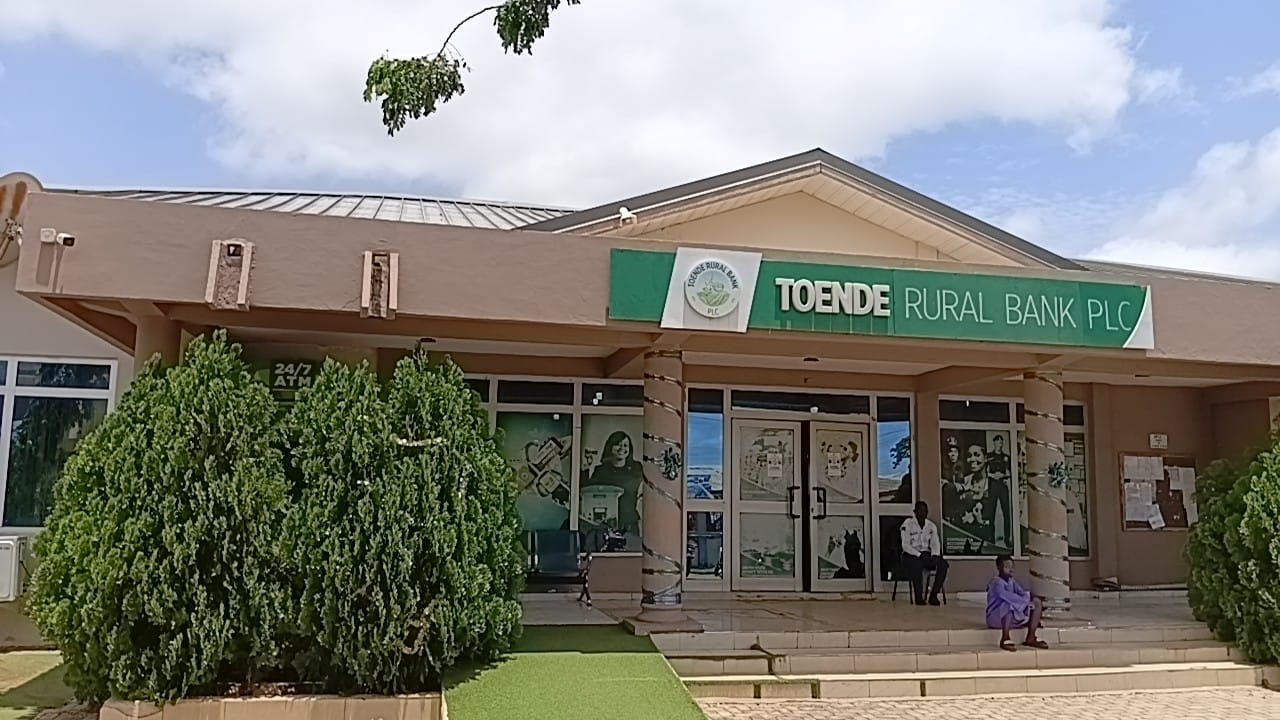
In a district where poverty, limited infrastructure, agricultural vulnerability and the lingering effects of conflict continue to constrain economic opportunities, access to finance has become more than a banking issue.
For residents of Bawku West District, particularly farmers, women entrepreneurs, traders and young people, the availability of financial services close to home can determine whether a small business survives, whether a farmer gets inputs on time, or whether a family can keep its children in school.
It is against this development challenge that Toende Community Bank says it has positioned itself not merely as a profit-making institution, but as a local financial vehicle for mobilising resources, supporting livelihoods and keeping money circulating within the communities it serves.
The bank’s Chief Executive Officer, Mr Atoka Salfu Gandhi, says the institution was established around 2004 partly in response to the financial exclusion confronting communities in the area.
According to him, before the establishment of the bank, workers, businesses and government institutions often had to travel to Bawku or Bolgatanga to undertake basic banking transactions.
That, he said, consumed valuable working hours and imposed additional costs on people in an already economically disadvantaged district.
“The establishment of the bank was to help mobilise local funds for those who are in need of it, at least for an economic improvement in the local area,” Mr Gandhi explained.
Banking as a tool for local development
For Toende Community Bank, the argument is straightforward: if financial resources can be mobilised locally and channelled back into productive activities within the same communities, banking can become an important instrument for local development.
Mr Gandhi said the bank’s mission is therefore centred on poverty reduction, improved wellbeing and wealth creation.
He stressed that the institution’s development role extends beyond conventional banking and profitability.
The bank, he said, currently serves more than 42,000 customers, many of whom might otherwise have limited interaction with formal financial institutions.
One example is the bank’s involvement in the government’s Livelihood Empowerment Against Poverty (LEAP) programme.
Mr Gandhi said the bank facilitates payments to between 5,000 and 6,000 beneficiaries whenever LEAP funds are released, bringing social protection payments closer to vulnerable residents.
For him, such services demonstrate why rural banking must be assessed not only by its financial returns but also by its contribution to the communities in which it operates.
Putting farmers at the centre
Agriculture remains the backbone of much of Bawku West’s rural economy, but farmers face persistent challenges ranging from access to capital and farm inputs to unpredictable rainfall and weak markets.
Toende Community Bank has therefore developed what it calls a cashless loan product for farmers.
Instead of handing the farmer the entire loan in cash, the bank pays input suppliers and other actors involved in the production process.
The model is intended to ensure that credit is used for its stated agricultural purpose.
Mr Gandhi said the bank recognised that some farmers could divert agricultural loans to other household or personal expenses, thereby undermining the purpose of the financing.
Under the arrangement, the cost of ploughing, inputs, pesticides and other farm requirements can be incorporated into the financing package, with payments made directly to the relevant service providers.
The farmer consequently gains access to the resources required to cultivate the farm without necessarily receiving a large amount of physical cash.
The bank also works with aggregators who help organise the various services required by farmers.
Keeping agriculture alive beyond the rainy season
Climate and weather uncertainty present another major challenge.
With rainfall becoming increasingly unreliable, dry-season agriculture has emerged as an important means of sustaining rural livelihoods.
Mr Gandhi said the bank uses the presence of the White Volta to support farmers engaged in dry-season production, including financing for pumping machines and other requirements.
The strategy, he explained, is designed to provide farmers with an alternative when the rains fail or when the main farming season produces poor results.
The bank has also adopted a flexible approach towards farmers who struggle to repay loans following poor harvests or depressed commodity prices.
Mr Gandhi cited the current maize market as an example, saying farmers who previously received financing are facing difficulties because the price of maize has fallen significantly.
Rather than immediately treating such farmers as failures, he said the bank has been rescheduling some loans and helping to identify markets for their produce.
This approach highlights an important principle in rural finance: agricultural lending cannot be separated from the risks created by weather, commodity prices and market access.
From borrower to tractor owner
The bank’s impact, according to Mr Gandhi, can be seen in the progression of some of its clients.
He cited the case of a farmer who started with support from the bank and has since acquired his own tractor.
The farmer has subsequently become part of the agricultural service chain, providing ploughing services to other farmers.
For the bank, the development significance goes beyond the success of one individual.
A farmer who acquires productive equipment can become a service provider, create additional income for himself and help other farmers gain access to machinery.
That is the type of multiplier effect rural finance can generate when credit is invested in productive assets.
Women turning small finance into businesses
Women also occupy a central place in the bank’s financial inclusion strategy.
Mr Gandhi said the bank has mobilised numerous women’s groups across its catchment area and provides them with microfinance support.
He estimated that between 800 and 1,200 women are currently benefiting from such financing arrangements.
The support extends to women involved in activities including rice parboiling and shea butter processing, among other businesses.
Some groups, he said, have eventually accumulated enough savings to operate independently of external credit.
For the bank, that is not a failure of lending but rather a measure of success.
Once a group has developed sufficient internal savings, the bank encourages members to use and rotate their own capital while continuing to provide business and financial education.
Creating opportunities for young people
Youth unemployment remains a major development challenge across many rural communities.
Mr Gandhi said Toende Community Bank has therefore introduced a product specifically targeting young entrepreneurs.
Under its SME loans for youth, promising young business owners can receive financing alongside advice on how to manage and expand their enterprises.
The bank assesses the nature and seasonality of a business before deciding how to structure financing.
A young entrepreneur whose business performs better during a particular season, for example, may receive a shorter-term facility designed around that business cycle.
The approach is intended to prevent young entrepreneurs from carrying unnecessary debt after the period during which they require the financing has ended.
The bank also sees support for existing businesses as an indirect response to unemployment.
Mr Gandhi argued that helping businesses expand can enable them to employ other young people, creating a chain of economic opportunities.
Taking the bank to the people
For communities located far from Zebilla, physical distance remains a barrier to formal financial services.
Toende Community Bank’s response has been to take banking services into the communities rather than waiting for residents to travel to the bank.
Mr Gandhi said staff visit market centres on market days, engage residents and sensitise them about banking services.
The bank also conducts outreach through churches and mosques.
The objective, he said, is to make rural residents understand that the bank belongs to the community and exists to serve its financial needs.
Such outreach is particularly important in areas where transportation costs and poor roads make regular visits to a bank branch difficult.
Financial literacy as part of poverty reduction
For Toende Community Bank, lending without education can create another cycle of indebtedness.
Mr Gandhi said financial education is therefore integrated into the bank’s microfinance programmes.
Beneficiaries receive business education as well as guidance on managing their finances.
The bank also provides health and hygiene education, sometimes involving health professionals.
The rationale is practical: when illness affects a household, money intended for business investment can quickly be diverted to medical expenses.
By strengthening household awareness and encouraging better health practices, the bank believes it can protect the productive capital of its clients.
When credit becomes a pathway to independence
One of the clearest examples cited by the bank is a farming group at Sapeliga.
Mr Gandhi said the group initially depended on support for rain-fed agriculture but gradually expanded into year-round farming through access to financing and the use of water resources from the White Volta.
After working with the bank for more than a decade, he said, the group has reached a point where it no longer needs external financing.
Similar progress, he added, has been recorded among women’s groups involved in shea butter production and rice parboiling.
The bank’s philosophy is that credit should ultimately help clients build enough productive capacity and savings to become financially self-reliant.
GH¢40–45 million in annual lending
Mr Gandhi estimates that the bank provides between GH¢40 million and GH¢45 million in loans annually.
He said the financing reaches thousands of people and supports a range of activities.
The impact, he argued, extends beyond business expansion to household welfare.
Some beneficiaries have reportedly used the proceeds of their economic activities to pay school fees and support their children through higher levels of education.
For a rural financial institution, such outcomes provide a direct connection between access to credit and human development.
Investing in education, health and identity
The bank’s development interventions also extend into corporate social responsibility.
In memory of its late founding father, Dr Bishop Jacob Ayebo, the bank is supporting a medical student who, according to Mr Gandhi, is currently at Level 500.
The intention is that the beneficiary will eventually complete his training and return to serve the community.
The bank is also supporting efforts aimed at promoting and developing the Kusaal language, including initiatives to produce educational materials.
Mr Gandhi said the initiative is rooted in the belief that development must include cultural identity.
For him, communities must understand and preserve their identity while pursuing economic and social progress.
The bank has also provided assistance to individuals requiring medical treatment, although Mr Gandhi said such interventions are too numerous to catalogue.
Conflict: A major obstacle to local economic growth
Despite these interventions, the bank’s development ambitions face a major structural challenge: the conflict around Bawku.
Bawku’s importance as a commercial centre means instability there has consequences far beyond the immediate conflict zone.
Mr Gandhi said Toende Community Bank has a branch in Bawku and has experienced the effects of disruptions to commercial activity.
Because Bawku’s economy is closely connected to surrounding communities, reduced commercial activity affects traders, farmers, transport operators and financial institutions across the wider area.
For the bank, conflict therefore represents not only a security concern but also a development constraint.
It limits where financial services can safely operate and restricts the bank’s ability to extend services into some communities.
Poor roads and digital connectivity
Infrastructure remains another barrier.
Mr Gandhi said poor roads make it difficult for bank staff and field officers to reach farmers and rural groups.
Some areas can only be reached using motorbikes.
Poor internet connectivity also affects digital financial services and the use of Point-of-Sale devices in remote communities.
When field officers travel into areas without network coverage, transactions and other operations can be disrupted.
Electricity challenges add another layer to the problem.
These difficulties demonstrate that financial inclusion cannot be achieved by banks alone. It depends on the wider infrastructure environment — roads, electricity, telecommunications and security.
The need to keep local money local
Mr Gandhi believes government can further strengthen rural development by making greater use of community-based financial institutions.
He argued that government funds intended for local development should, where appropriate, be channelled through institutions operating within the communities they are meant to serve.
His argument is based on the principle that locally mobilised funds can be more directly connected to local economic activity.
“If you deposit your money at the bank, we keep the funds here and use those same funds to give to others and we grow together,” he explained.
He said a better understanding of rural banking is therefore necessary, particularly the fact that rural banks can mobilise local savings and lend those resources to local businesses, farmers and households.
Beyond banking
The experience of Toende Community Bank illustrates a broader development question facing rural Ghana: how can financial institutions become engines of local economic transformation rather than simply places where people deposit and withdraw money?
In Bawku West, the answer increasingly appears to lie in linking finance with agriculture, entrepreneurship, education, social protection and community development.
The bank’s interventions do not eliminate the structural problems facing the district. Poor roads remain. Internet connectivity remains unreliable. Agricultural risks persist. Youth unemployment remains a concern, while conflict continues to affect economic activity.
But the institution’s experience demonstrates the potential of local finance to create economic linkages — from a farmer accessing inputs, to a woman expanding a processing business, to a young entrepreneur employing others, and ultimately to families using increased incomes to educate their children.
For a district seeking to move beyond poverty, that connection between finance and productive capacity may be as important as the money itself.
The larger development lesson is clear: rural banking can become a tool for poverty reduction when credit is deliberately connected to productive activities, financial literacy, market access and community needs.
For Toende Community Bank, the ambition is not simply to grow a bank. It is to help grow the communities around it.