
 By Ishmael Junourgh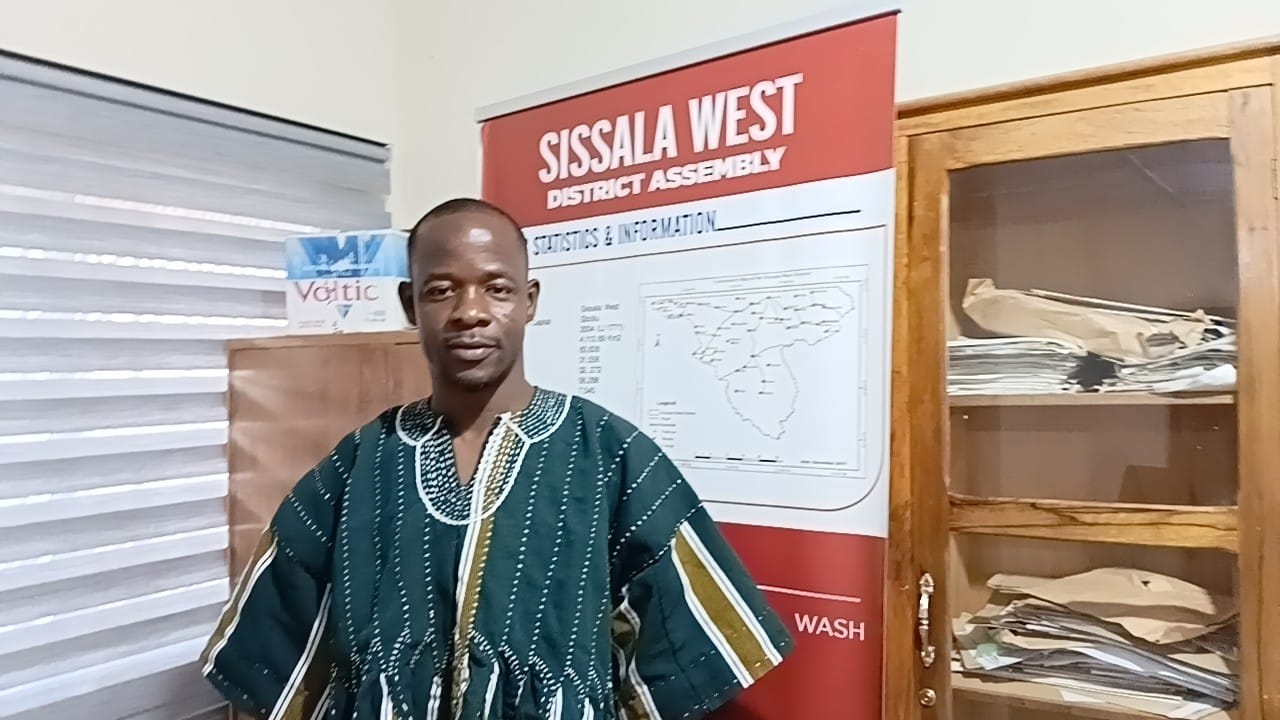
Sissala West District may not be one of Ghana’s most talked-about districts, but its contribution to the country’s food security, its historical heritage and its proximity to Burkina Faso give it a strategic importance that extends far beyond its borders.
Yet, according to the District Chief Executive (DCE), Hon. Abudu Fuseni Benne, one persistent challenge threatens to undermine these opportunities: poor road infrastructure.
For the DCE, the problem is so severe that when asked to identify the district’s three biggest development challenges, she gave the same answer three times: “Roads. Number two, roads. Number three, roads.”
The assessment captures the development dilemma facing a predominantly agrarian district where farmers produce food for markets far beyond the Upper West Region, but often struggle to transport their produce from farms and communities to those markets.
An agricultural powerhouse with untapped potential
Sissala West is one of the 11 districts in the Upper West Region and shares boundaries with Sissala East, Lambussie, Jirapa and Daffiama-Bussie-Issa, while its northern boundary stretches along Burkina Faso.
The district capital, Gwollu, itself sits close to the international boundary.
Agriculture dominates the local economy, with maize and other cereal crops forming the backbone of production. According to the DCE, approximately 99 per cent of the district’s population is engaged in agriculture, alongside livestock, poultry and other forms of animal husbandry.
The scale of production, she argues, is not sufficiently appreciated nationally.
She pointed to the achievements of Dimah Benne Idrisu John, a native of the district who became Ghana’s national best maize farmer around 2019.
His success, she said, helped inspire other farmers whom he mentored, many of whom are now producing maize across the district.
“More than 50 per cent” of the maize transported from northern Ghana to southern markets comes from Sissala West, the DCE claimed, highlighting the district’s potential as a major contributor to Ghana’s food supply.
But that agricultural strength is being undermined by a basic logistical challenge: getting the produce to market.
When roads become a threat to food security
For farmers in Sissala West, poor roads are not merely a transportation inconvenience. They can determine whether harvested food reaches consumers or is lost before it gets to market.
The DCE said the Assembly is forced to undertake temporary road maintenance where possible, but limited resources make it difficult to provide lasting solutions.
“I have to go and check and then see immediately what as an Assembly we can do,” she explained, adding that the Assembly can only manage some roads temporarily to keep communities connected.
The situation is particularly worrying during periods when feeder and community roads become difficult or impossible to use.
With agriculture serving as the district’s economic foundation, poor roads contribute to post-harvest losses, limit farmers’ access to markets and make movement between farming communities and commercial centres more difficult.
The DCE therefore believes road investment must be treated as an economic intervention, rather than simply an infrastructure project.
Wa-Tumu and Tumu-Hamile corridors critical to the district
Among the roads the Assembly considers priorities are the Wa-Tumu road and the Tumu-Hamile corridor.
The Wa-Tumu road is particularly important because Sissala West produces large quantities of food that are consumed in markets further south.
“The food produce that we get from the farm, inaccessible roads lead to post-harvest losses,” she said.
The Tumu-Hamile road has an additional strategic importance because Hamile serves as a transit point towards Burkina Faso and connects Ghana to wider regional trading routes, including routes towards Côte d’Ivoire.
The DCE said the Wa-Tumu road is currently under contract through the government’s Big Push programme, with work ongoing.
She, however, expressed concern about the pace of work on the Tumu-Hamile-Wa corridor, describing the contractor’s progress as “not encouraging.”
For residents and farmers, the quality and speed of work on these roads could have implications far beyond travel time. Improved roads could reduce transportation costs, improve market access and strengthen Sissala West’s role in Ghana’s agricultural supply chain.
The hidden tourism wealth of Gwollu
While agriculture remains the district’s economic engine, Sissala West also possesses historical and cultural assets with significant tourism potential.
One of its most important landmarks is the Gwollu Slave Defence Wall, a historical site associated with the community’s resistance to slave raiding.
The site has been preserved and includes a museum and tourist centre where visitors can learn about its history.
The district is also historically significant as the birthplace of Dr. Hilla Limann, Ghana’s third President of the Fourth Republic, who hailed from Gwollu.
Yet the DCE believes the district has not sufficiently capitalised on these assets.
She argues that more publicity is needed to project Sissala West as a destination for historical and cultural tourism.
“We need to intensify more publicity,” she said.
Where crocodiles are tied to identity and tradition
Perhaps one of the district’s most intriguing cultural attractions is its crocodile pond at Gwollu.
Unlike the popular association of crocodile tourism with Paga, the DCE says Gwollu also has a long-standing cultural relationship with crocodiles.
According to her account, a clan within the Sissala community traces a historical connection to the animals, with members traditionally associated with crocodile representations in their names.
The belief goes further: when a particular crocodile dies, it is traditionally interpreted as being connected to the death of a member of the associated clan.
The DCE recounted stories of elderly residents whose lives were believed to have been symbolically connected to particular crocodiles.
Such traditions, she suggested, represent a distinctive form of cultural and ecological relationship that could add another dimension to the district’s tourism appeal.
For Sissala West, therefore, tourism development could combine history, culture, traditional beliefs and ecological heritage.
Development beyond the highways
While major roads attract attention because of their economic importance, the DCE stressed that the more immediate connectivity crisis is often found on smaller community roads.
She cited several routes linking communities such as Jalie, Zini, Han, Fielmuo and Tiwii to major centres.
These roads, she said, are crucial to everyday life but often receive less attention than major highways.
“The roads I mentioned are just highways,” she explained. “Those are economic zones. But those small, small roads… that is where the problem is.”
This distinction is critical in a district where farmers, schoolchildren, health workers and traders depend on community roads to access essential services.
Education infrastructure improving, but access remains a challenge
The district has also made progress in educational infrastructure, according to the DCE, with support from the Member of Parliament, the District Assembly and GETFund contributing to the construction and expansion of schools.
However, infrastructure expansion has not completely eliminated the problem of physical access.
In Buu, for instance, the dispersed nature of the settlement means some children reportedly travel more than three kilometres to reach school.
For young children, that distance can become a serious barrier to education.
Lilimie faces a similar challenge because of its linear settlement pattern, with the school located at one end of the community.
Even in Gwollu, the expanding district capital, some settlements have become sufficiently distant from existing schools to create access difficulties.
The challenge, therefore, is no longer simply about building schools but ensuring that educational facilities are located close enough to the communities they serve.
Health and electricity: progress amid infrastructure gaps
The DCE said the district has also recorded progress in other areas.
Between 45 and 50 per cent of the district, she indicated, has access to primary healthcare through Community-based Health Planning and Services (CHPS) facilities.
Rural electrification, meanwhile, has reached more than 90 per cent coverage, according to the Assembly’s assessment.
These gains provide a foundation for further development, but the DCE believes poor road connectivity continues to affect the effectiveness of these services, particularly for rural communities.
A district at a crossroads
Sissala West presents a striking development paradox.
It is a major agricultural production zone, strategically positioned along Ghana’s northern frontier, home to important historical sites and the birthplace of a former Ghanaian president.
It also possesses distinctive cultural and ecological attractions that could support tourism.
Yet much of this potential remains constrained by inadequate road connectivity.
For Hon. Ayisha Fuseni Benne, the priority is therefore clear: connect the communities, improve the roads and create the conditions for agriculture, commerce, education, healthcare and tourism to flourish.
The district’s development story is ultimately not about a lack of potential. It is about whether infrastructure can catch up with that potential.
If the roads improve, Sissala West could strengthen its position not only as one of the Upper West Region’s agricultural engines but also as a gateway for trade, a centre of historical tourism and a critical link between Ghana and its neighbours to the north. For a district that produces food for consumers far beyond its borders, the road to development may literally begin with the road to the farm.