
 By Ishmael Junourgh
Wa Central NDC Communications Officer Aspirant says Ghana’s gold sector deserves informed debate, evidence-based scrutiny and a national-interest approach
The growing political debate over the operations and policies of the Ghana Gold Board (GoldBod) has drawn a firm response from Alhaji Bitis, an NDC Communications Officer Aspirant for Wa Central, who has declared his support for Sammy Gyamfi and urged political actors to prioritise facts, accountability and Ghana’s development interests.
Alhaji Bitis, in a strongly worded position, said he “stands with Sammy Gyamfi” in defending GoldBod and what he describes as efforts to protect Ghana’s gold resources and ensure that the country derives greater economic value from its mineral wealth.
His intervention comes amid heightened political exchanges over GoldBod, with the NDC communicator arguing that legitimate concerns about the institution should be addressed through evidence and the appropriate accountability mechanisms rather than what he considers political sensationalism.
Gold wealth must translate into national development
At the heart of Alhaji Bitis’ argument is a broader development question: how Ghana can capture more value from its gold resources and ensure that the country’s mineral wealth contributes meaningfully to economic transformation.
He argues that Ghana’s long history as a major gold producer has not always translated into commensurate economic benefits for ordinary citizens.
For him, any effort designed to strengthen Ghana’s position in the gold value chain, improve transparency, formalise aspects of the sector and enable the country to capture greater value from its natural resources deserves serious public discussion.
“The bigger question is: What is in the best interest of Ghana?” he asks.
Alhaji Bitis believes the GoldBod debate should therefore move beyond partisan confrontation and focus on whether Ghana’s gold sector is being structured in a manner that maximises national benefit.
“Bring the evidence”
While acknowledging the importance of opposition scrutiny, the Wa Central Communications Officer Aspirant says criticism of GoldBod and its officials must be grounded in verifiable evidence.
He challenged those raising concerns about the institution to produce documentation where allegations involve specific transactions or possible wrongdoing.
“If there are genuine concerns about GoldBod, bring the evidence. If there are questions about transactions, show the documents. If there are allegations of wrongdoing, let the appropriate institutions investigate them,” he said.
He maintained that allegations should not automatically be treated as established facts simply because they are repeated in political or public discourse.
For Alhaji Bitis, this distinction is critical to protecting both democratic accountability and public confidence in state institutions.

Defending Sammy Gyamfi without rejecting accountability
Alhaji Bitis’ support for Sammy Gyamfi, however, does not amount to a rejection of scrutiny.
He acknowledges that public officials and government communicators must be questioned and held accountable where necessary.
But he draws a distinction between legitimate accountability and what he regards as attempts to intimidate or discredit individuals through sensational claims.
“Accountability is not persecution. Criticism is not intimidation. Opposition politics is not a licence to distort facts,” he argues.
He consequently rejects what he describes as attempts to use the GoldBod controversy to create unnecessary public fear or undermine legitimate efforts to reform Ghana’s gold sector.

Beyond Sammy Gyamfi versus Afenyo-Markin
Alhaji Bitis also cautions against reducing the GoldBod debate to a personal or partisan contest between Sammy Gyamfi and Majority Leader Alexander Afenyo-Markin.
In his view, such framing risks obscuring the more important national development question.
He acknowledges Afenyo-Markin’s political experience and right to scrutinise government policies, but insists that political authority must be accompanied by responsibility.
For him, robust opposition is necessary in a democracy, but it must be constructive and evidence-based.
“The bigger question is: What is in the best interest of Ghana?” he asks, insisting that the gold sector must ultimately be judged by its contribution to Ghana’s economic interests.
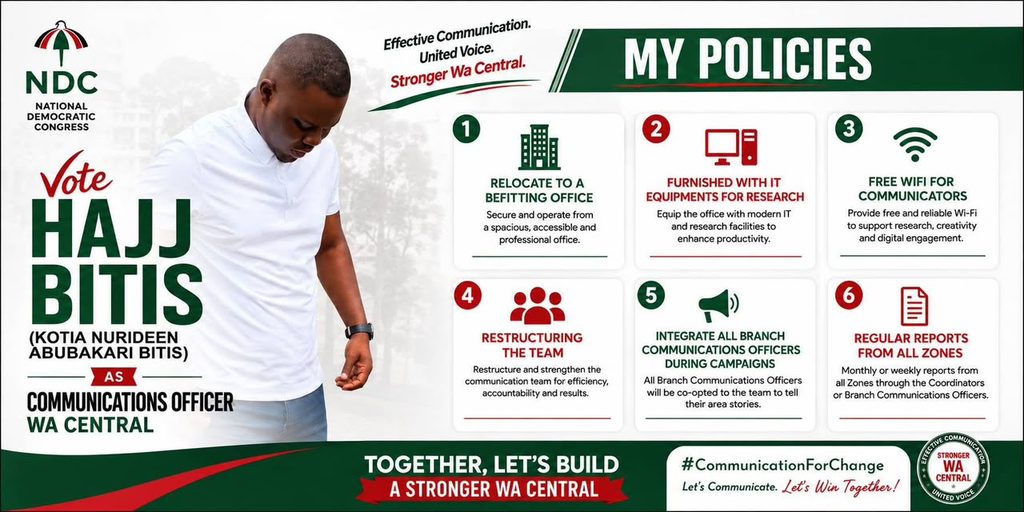
A new communications agenda for Wa Central
Beyond the immediate GoldBod controversy, Alhaji Bitis is using the issue to outline the kind of political communication architecture he says he wants to build if elected Communications Officer for the Wa Central NDC.
He says his ambition is not simply to occupy an organisational position but to build a communications team that is “bold, disciplined, factual, united and ready to defend the party’s record and policies.”
He believes political communication at the constituency level must evolve beyond partisan rhetoric and become a vehicle for explaining government policies, confronting misinformation and connecting national programmes to the everyday development concerns of constituents.
“Our communication must not be timid. We must not run away from difficult conversations. We must confront misinformation with facts and propaganda with evidence,” he says.
That approach, he argues, would enable the Wa Central NDC to communicate more effectively with citizens while giving constituents clearer information about government policies and their potential implications for development.
Positioning communication as a development tool
For Alhaji Bitis, effective political communication is not merely about defending a political party.
It is also about helping citizens understand policies that affect their livelihoods, resources and future.
His intervention on GoldBod therefore reflects what he presents as a wider philosophy: that communicators must be prepared to defend national-interest policies while remaining open to legitimate scrutiny.
He says he intends to bring courage, discipline and factual communication to the Wa Central NDC if given the mandate.
“Let the facts speak”
Alhaji Bitis has ultimately framed his GoldBod position as a choice between political noise and evidence-based public discourse.
“I stand with Sammy Gyamfi,” he declares, while stressing that his broader position is rooted in what he describes as the defence of Ghana’s interests, responsible management of natural resources, transparency, accountability and opposition to misinformation and political intimidation.
For Wa Central, his intervention provides an early indication of the communications style he is seeking to promote ahead of the constituency’s internal contest: assertive, policy-focused and development-oriented.
His message is straightforward: political disagreement is legitimate, scrutiny is necessary, but the national interest should remain at the centre of the conversation. “Enough of the noise. Let the facts speak. Let Ghana win.”