
 By Zakaria Rafique Seinu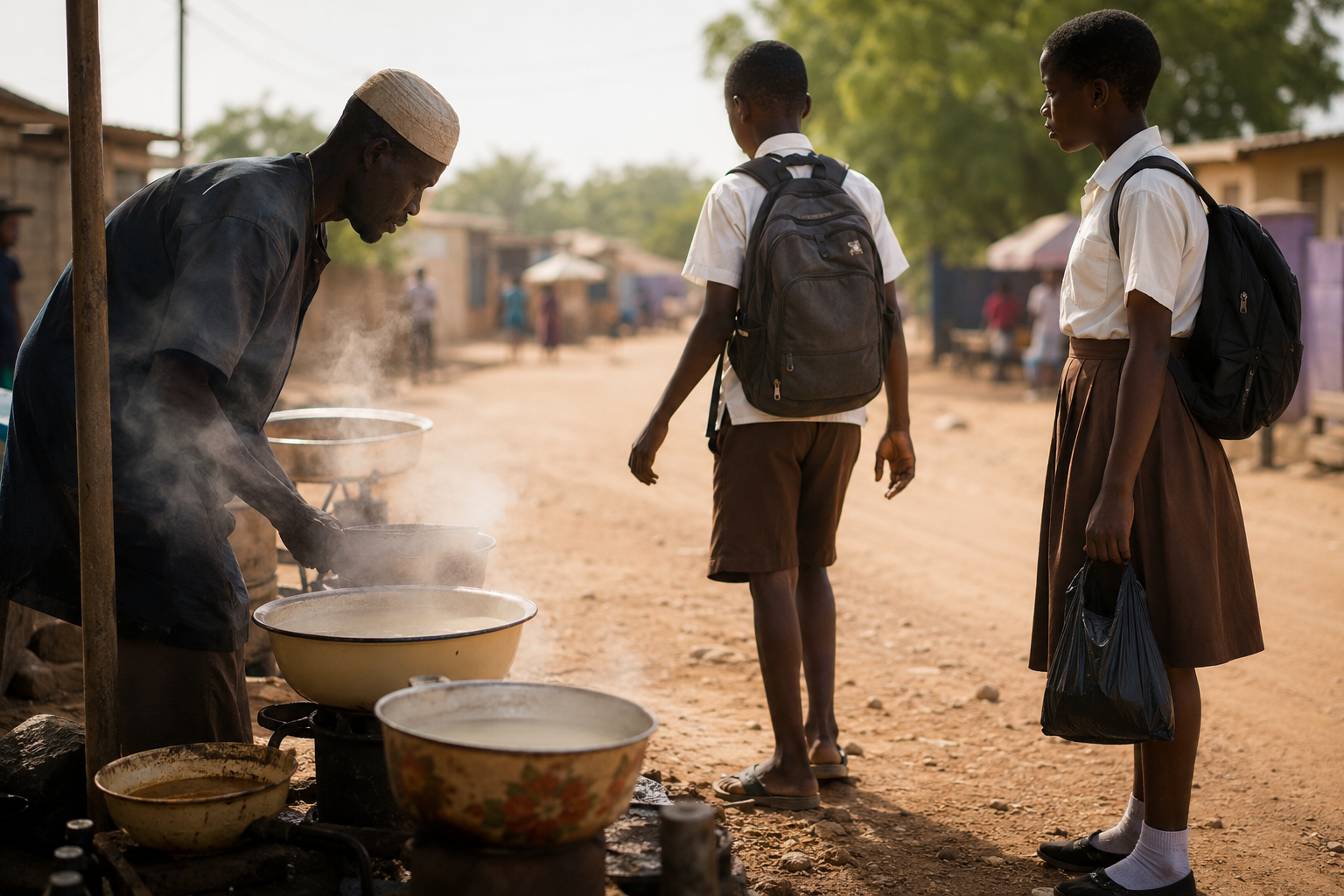
It all started during those sweet days when I was a student at Wa T.I Ahmadiyya JSS and residing somewhere around Kambali. People call those years “school days,” but for me they were honey days. Sticky, slow, and golden.
I can hardly remember where I left my cap on a Monday morning. The JSS cap with the sweat stains and the loose elastic. I can hardly remember what I ate for break on Wednesdays. But I can remember, with a clarity that still makes my chest do a small jump, the first girl I ever felt in love with.
I still remember the talcum powder on her neck. That faint white line right where the collar of her uniform ended. And oh, the pomade. Was it cocoa butter or Alata cream? Hmm. Even now I argue with myself about it. Cocoa butter had that richer smell. Alata cream had that shine. Whichever it was, it caught the afternoon sun as she walked, and for a boy of 13, that was enough to rewrite the whole day.
The first time I saw her, she was coming from school. It wasn’t planned. Life in Kambali and around the T.I. school had a way of throwing people together at the same borehole, the same corner, the same narrow path that cut between houses. By chance, our eyes met.
I smiled. A big, nervous, toothy smile that I had practiced in the mirror but never actually used on a human being. She made no response. But at least, she had seen me. That was the victory I carried home. She had seen me.
After that, I started dreaming about her. Not the dramatic Hollywood kind of dreams at first. Just small ones. Walking past her. Sitting two rows behind her in class. Buying ice water at the same time. We still never talked. We smiled at each other whenever we met, and that was a whole language by itself. One smile meant “I see you.” Two smiles meant “maybe tomorrow.”
For several days, just her feminine properties kept me thinking like a philosopher in search of an answer to one of the puzzles of life. Why did she tie her hair that way? Why did she walk with her books hugged to her chest? Why did the powder sit so neatly on her neck? I had no answers, so I did what every confused teenage boy does. I started grooming myself.
I would wash my shirts, trousers, boxers and singlets and iron them neat. Neat in the way that makes the crease on your trousers sharp enough to cut air. For the first time in my life, I bought a white handkerchief. I did not have a cold. I did not need it. I just needed to have something in my pocket that said “I am prepared.” As for the shoes, I overpolished them. Thanks to Mr. Anani, my leatherwork teacher, who taught us that shine is a kind of respect. I used kiwi, brush, and a lot of spit, until you could see a distorted version of your face in the toe.
Those were days when it was generally believed that guys who lived in government bungalows spoke better English than those of us in the compounds. In the compounds, the only English you heard before 7am was “good afternoon” from school boys and girls practicing for when they would meet a teacher. It was a joke we all laughed at, but it also sat in our minds.
Well, I was not one of those guys who could not put one or two English words together. I read anything. From the alphabets to “zero.” Books like THE STUDENT COMPANION, COMMON MISTAKES IN ENGLISH became my companions. I carried them the way other boys carried football magazines. I underlined. I copied sentences into an exercise book.
The other important factor that built my confidence in the Queen’s language was that my teachers were very good. Mr. Carlos Kofi Ballans, our English language teacher, was super. Thump up, Sir. You taught us with a ruler in one hand and patience in the other. You were given six strokes of the cane called BLACK JOE for speaking any of the local dialects at school. We hated it then. We understood it later. That fear made us listen carefully, pronounce slowly, and think before we spoke.
In order not to disgrace myself should I meet my first lady, I started reading newspapers. This was the serious part. I could not afford a single edition of the dailies. Five cedis was a lot when koko was one cedi and bread was two. So I arranged with a friend to get me some from his father’s library. His father worked at the regional office and brought home Daily Graphic and Ghanaian Times.
I chewed them like nkatie burgher. Front page to back page. I did not understand half the politics. I did not care about the sports scores. But I circled new words. “Alleged.” “Consequently.” “However.” I said them out loud in the bathroom. I wrote them on the margins of my math book. I was building armor. Because what if one day I had to speak to her? What if she asked me a question and I answered with broken English and the boys in government bungalows laughed?
Fate, as it always does, arranged a test.
One day, my father sent me to buy Hausa koko. Early morning, still misty, the air smelling of millet and pepper and charcoal. I was not ready. I had not taken my bath. Worst of it all, I was on locally made slippers popularly known as Dakuleda here in Wa. The ones with the thick sole and the straps that slap your heel when you walk fast.
And there she was. At the koko seller’s stand. Buying for her household too, probably.
Heeer. My brain short-circuited. Don’t ask me why ooo. I scurried away. Not a dignified walk. A scurry. Head down, Dakuleda slapping, koko money sweating in my palm. I told myself I would come back later. I told myself I would be clean next time. I told myself there would be a next time.
There wasn’t. At least, not the kind I imagined.
I have been looking for her since then. Not in a desperate way. More in a wondering way. I don’t know her name. I never asked. We never got past the smiles. So PLEASE, if you come across her anywhere within your vicinity, tell her. Just tell her I loved her. I will be waiting to hear from you under the cashew trees at Wa T.I Ahmadiyya JHS.
The cashew trees are still there, I think. Big, patient trees that drop fruit in season and give shade to students who are hiding from teachers or hiding from their own thoughts. That is where I used to sit and read the newspapers I borrowed. That is where the journey really started.
Because here is the thing. From a romantic trip, I eventually fell in love with books.
The girl was the spark. The fear of disgracing myself was the fuel. But the fire became something bigger than her. I love reading. I enjoy it. Not because I want to impress anyone anymore. But because somewhere between “consequently” and “however,” I found out that words could carry you out of Kambali and into anywhere.
Reading taught me that the boys in government bungalows did not own English. Anyone who was willing to chew newspapers and take six strokes of BLACK JOE could own it. Reading taught me that you could be in Dakuleda slippers and still have ideas that shine like overpolished shoes. Reading taught me that a smile across a school path could change the direction of a life.
Mr. Ballans probably never knew. Mr. Anani probably never knew. My friend whose father had the library probably never knew. The girl with the powder and the pomade definitely never knew. But all of them were part of it.
Now when I think back to Wa T.I Ahmadiyya JSS, I don’t just think of classrooms and assembly and late-coming punishments. I think of a boy trying to iron dignity into his shirt. I think of a white handkerchief that never got used. I think of a pair of shoes that reflected the sky. I think of a girl who never spoke but taught me how to speak better.
I think of Hausa koko mornings and missed chances and the sound of Dakuleda on dusty ground. And I think of sitting under cashew trees, turning pages, and realizing that love, in any form, makes you want to become more.
So if you ever see her, tell her. Tell her the boy who smiled and ran away ended up okay. Tell her he kept reading. Tell her he still remembers the powder.
And tell her thank you. Because sometimes the people who never say a word to you end up saying the most important thing of all: become better.
I’m still under those cashew trees, in a way. Just now the trees are in different places, and the books are different, but the habit is the same. Read. Learn. Polish yourself. Be ready. Honey days don’t last. But what they start in you can.
 Ishmael Junourgh