
 By Zakaria Rafique Seinu
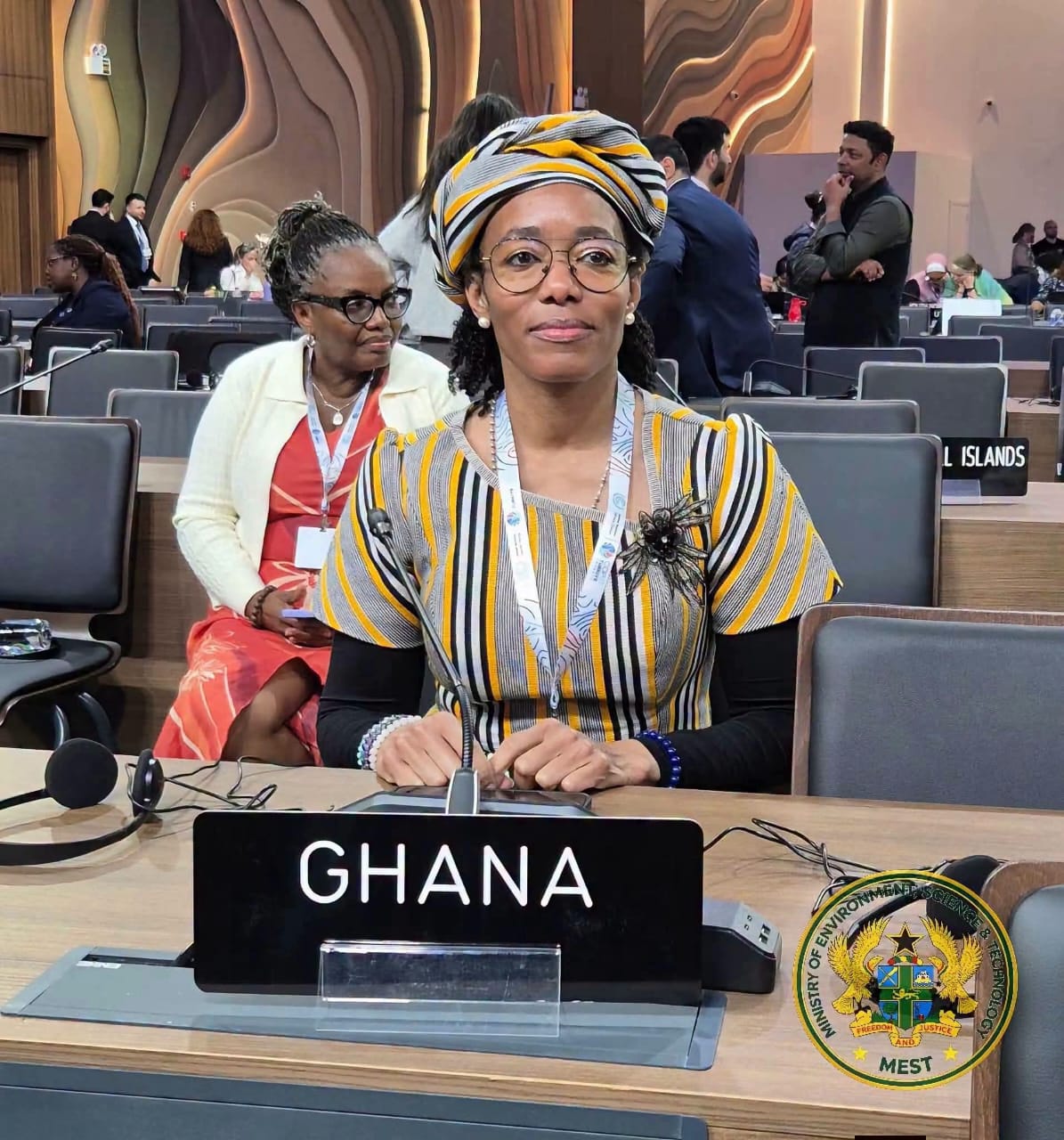
ANTALYA, TURKIYE
The microphone went silent after about a minute.
It was Sunday, 22 November 2026, the closing plenary of COP31. The summit, scheduled to run from 9 to 20 November, had already overshot its close by nearly two days. Nearly 200 countries had failed to secure a comprehensive agreement. The hall was exhausted, frustrated, and on edge.
Ghana’s Minister for Environment, Science and Technology, Dr. Zanetor Agyeman-Rawlings, was on her feet. She was not speaking for Ghana alone. She was speaking for the African Group of Negotiators, all 54 African countries, which Ghana currently chairs.
She had begun to explain why the proposed final agreement fell short of Africa’s expectations, particularly on adaptation finance, when COP31 President Murat Kurum intervened.
If you have a statement regarding the decision I just read, please share it. If you have no opinion on this topic, delegates who request to speak will be given the floor when their topic comes up, Kurum said.
Her statement was stopped. What happened next is why the world is still talking about Antalya.
WHAT SHE DID
Agyeman-Rawlings did not shout. She did not walk out. She did not accept the interruption as normal.
First, her delegation acted. Nana Dr. Antwi-Boasiako Amoah, Chair of the African Group of Negotiators and also from Ghana, rose immediately: With all due respect, Mr President, you’ve not shown respect to a group of 54 countries and my country, for that matter. You cut us in the middle of the conversation. This is not acceptable, Mr President.
Then, when she regained the floor, Agyeman-Rawlings spoke with precision, not anger:
I note, with extreme disappointment, the fact that when another party was speaking to the cover decision, the delegate was allowed to speak uninterrupted, but I was rudely cut off during my delivery by your good self. This, Your Excellency, is an example of the levels of disrespect that we have endured and continue to express our objection to. It absolutely does not respect multilateralism.
She added a personal fact that made the procedural point human: I have changed my flights twice and extended my stay by a few days in order to fulfil my obligation to be a part of this Conference of the Parties.
And she invoked principle, not personality: Your Excellency, be aware of the principle of primus inter pares, first among equals, and I take this opportunity to state that there is a code of conduct during our deliberations, and yours towards me was unacceptable.
That is what she did. She named the act. She compared the treatment. She cited the rule. She demanded the floor back. And she got it.
She then completed Africa’s statement. She criticised the draft’s commitment to triple adaptation finance by 2035, arguing that it lacked a clear baseline and specific funding figures. She questioned the Antalya-Addis Ababa plan, saying it would result in a report rather than concrete action. On loss and damage, she noted that the proposal contained no resource targets. On trade, she faulted the lack of a dedicated agenda item and firm rules on unilateral measures. On just transition, she argued the brief reference to a fair transition failed to reflect Africa’s development realities.
A commitment without a baseline cannot be called finance. For millions of children, youth, women and men in communities already facing floods, droughts and food insecurity, a commitment without a baseline cannot be called finance, she said. We didn’t come here to beg. We came here to claim what is rightfully ours.
THE APOLOGY, AND WHY IT WAS NOT ENOUGH FOR SOME
Kurum later apologised, both privately and publicly, saying he had not intended to disrespect Ghana or the African negotiating group. Agyeman-Rawlings was then allowed to complete her statement.
In a video shared by Citi FM, Kurum was seen holding Agyeman-Rawlings’ hand as he addressed her through an interpreter: There is no way for us to accept any attempt to interrupt you or anyone from your continent, let alone a valuable lady like you. It never crossed my mind.
Agyeman-Rawlings accepted the apology, saying disagreements were inevitable in international climate negotiations but should not undermine the spirit of cooperation. I think that at forums like this, it is easy to get frustrated during the process, and I understand that it can be something else when there is no consensus around issues. We are all here as representatives. We are here for one another.
Later, Kurum told reporters the interruption was a procedural error. He said he had intended to prevent groups from disrupting the meeting, that he had been trying to manage an unruly plenary, and that there had been no intention to single out Ghana. He also defended telling UN climate chief Simon Stiell to take your seat in the same chaotic session, saying no official could interfere with Turkiye’s presidency.
This is where a fair, balanced account must pause.
Was this deliberate disrespect of Africa and of a woman? Or was it a tired chair, under immense pressure after nearly 50 hours of overtime, making a procedural mistake in a collapsing summit?
There is no evidence that Kurum deliberately singled out Africa. The summit ended without an agreement after the European Union, the United Kingdom and other delegations rejected the draft over its failure to address fossil fuels. In that context, the chair was trying to push a text through a deeply divided room.
But there is also clear evidence of unequal treatment in that specific moment. Another delegate had been allowed to speak without interruption. Agyeman-Rawlings was not. That fact, not motive, is what she challenged. And in diplomacy, perception of fairness matters as much as intention, because trust is the currency of multilateralism.
The apology itself also drew criticism, including in Turkiye. Some commentators called the prolonged hand-holding unprofessional and questioned why the minister’s gender came into it at all, a valuable lady like you, when she was there as a minister representing 54 states, not as a lady to be protected. One reply to Citi FM asked what the minister’s gender had to do with the apology.
That criticism is important. It shows that even an apology can reproduce the very problem it seeks to fix: reducing a woman’s authority to her womanhood, rather than recognising her office.
Agyeman-Rawlings handled that too, with composure. She accepted the apology without surrendering the point. She did not make the moment about herself. She made it about procedure, equality, and Africa’s substantive demands.
That is why many observers, including etiquette coach Nancy Adobea Anane, praised her for composure, emotional intelligence and diplomatic maturity and quiet confidence. She expressed dissatisfaction without resorting to unnecessary confrontation. That is not weakness. That is discipline.
WHY THIS WAS NOT JUST ABOUT A MICROPHONE
To understand Antalya, you must understand what was at stake.
COP31 collapsed without an overarching agreement. The African Group described the outcome as deeply disappointing, saying the conference failed to provide a meaningful roadmap for implementing climate commitments, particularly the tripling of adaptation finance. At COP30 in Belem, countries had committed to tripling adaptation finance by 2035. At COP31, the commitment was retained without a specific financial target.
For Africa, this is not abstract. Africa contributes the least to global emissions but suffers disproportionately from floods, droughts, coastal erosion, and food insecurity. When a delegate is cut off while speaking about adaptation finance, it feels like the substance and the procedure are telling the same story: Africa’s pain is acknowledged, but Africa’s voice is managed.
That is why Agyeman-Rawlings’ intervention resonated far beyond the plenary hall. It became a symbol of a larger frustration: global leaders speak of inclusion, equality and partnership, while smaller and less influential countries can struggle to have their concerns heard.
A PATTERN AFRICAN WOMEN KNOW TOO WELL
Agyeman-Rawlings was not the first African woman to be talked over, sidelined, or diminished in a room where she had every right to speak.
In April 2021, in what became known as Sofagate, European Commission President Ursula von der Leyen was left without a chair during a meeting with Turkish President Recep Tayyip Erdogan, while her male counterpart, European Council President Charles Michel, took the only chair beside Erdogan. She was forced to sit on a sofa at a distance. The image went viral because it made visible what many women in diplomacy experience invisibly: being present, but not counted as equal.
In Kenya, Nobel Laureate Wangari Maathai was repeatedly arrested, beaten, and dismissed as a troublemaker for defending the environment and women’s rights, long before the world celebrated her. In Liberia, Ellen Johnson Sirleaf, Africa’s first elected female head of state, was routinely questioned on her toughness, her age, and her right to lead in a political culture that had never seen a woman president.
In Nigeria, Dr. Ngozi Okonjo-Iweala’s path to leading the World Trade Organization was marked by resistance, delays, and open attempts to block an eminently qualified African woman. In Ghana itself, women parliamentarians have spoken of being heckled, interrupted, and reduced to their appearance or marital status, rather than their arguments.
None of these cases is identical to Antalya. Sofagate was about protocol. Maathai was about state repression. Okonjo-Iweala was about institutional politics. But they share a thread: when a woman, especially an African woman, speaks with authority, the room often finds a reason to make her wait, to make her smaller, to make her repeat herself.
That is why Agyeman-Rawlings’ calm refusal mattered. She did not ask for special treatment as a woman. She demanded equal treatment as a minister. That distinction is crucial. Feminist leadership is not about asking to be protected. It is about insisting on being heard on the same terms as everyone else.
THE HISTORY BEHIND HER NAME
To understand her boldness, you must understand the name she carries.
Dr. Zanetor Agyeman-Rawlings is the eldest daughter of former President Jerry John Rawlings and former First Lady Nana Konadu Agyeman-Rawlings. She was born on 1 June 1978 in Accra, educated at Achimota School and Wesley Girls’ High School, and trained as a medical doctor at the Royal College of Surgeons in Ireland. She practised medicine for more than a decade before entering politics in 2015. She was first elected Member of Parliament for Klottey-Korle in 2016, and re-elected in 2020 and 2024, securing a margin of more than 16,000 votes in 2024. She holds a Master’s in Conflict, Peace and Security from the Kofi Annan International Peacekeeping Training Centre, and qualifications in defence management, conflict and crisis management, and women, peace and security.
But her political formation began at home, beside her mother.
Nana Konadu Agyeman-Rawlings, who died on 23 October 2025 at age 76, was Ghana’s longest-serving First Lady and a pioneer of women’s rights in Ghana. Her name, Konadu, meaning fight till the end, reflected a lifelong dedication to justice and equality. She was named after Nana Konadu Yiadom II, the revered Asante Queen Mother who ruled in the absence of the exiled Asantehene in 1896.
In 1982, Nana Konadu founded the 31st December Women’s Movement. At its peak, it claimed over two million members, established more than 870 preschools, and advanced programmes in literacy, health, family planning, and entrepreneurship. Her advocacy led to landmark legal reforms, including the Intestate Succession Law (PNDCL 111), which secured inheritance rights for widows and children, and helped embed gender equality provisions in Ghana’s 1992 Constitution. Through her efforts, Ghana became the first country to ratify the UN Convention on the Rights of the Child in 1991.
She was also a political trailblazer in her own right. In 2011, she became the first woman to contest the leadership of the National Democratic Congress. In 2016, she became the first woman to run for President of Ghana, on the ticket of the National Democratic Party she founded. She wrote in her memoir, It Takes a Woman, that her desire was to see the emancipation of women at every level of development.
That legacy is inevitably mixed, as historians note. The 31st December Women’s Movement was closely tied to the revolutionary state, and critics questioned its partisan nature and access to state support. Nana Konadu blurred boundaries between the personal and the political, revolution and reform. But even her critics acknowledge that she redefined what a First Lady could be, not ceremonial, but consequential, and that she built a grassroots machine that gave rural women literacy, income, and a voice.
Zanetor grew up watching that. She spent much of her childhood with her mother while her father led the state. She watched a woman build schools, confront chiefs, lobby for laws, and refuse to be ornamental.
In Antalya, that inheritance was visible, but so was her own formation. She did not invoke her parents. She did not invoke her surname. She invoked procedure, multilateralism, and the Code of Conduct. She spoke as a doctor who had earlier in the summit reportedly performed CPR and provided first aid after a woman collapsed, a woman who heals, and as a minister who would not let a continent’s statement be cut short.
That combination, the mother’s fight, the daughter’s discipline, is what made the moment powerful.
THE QUESTIONS ANTALYA MUST ANSWER
A good feature must not end with applause. It must ask questions.
1. Who decides who gets heard? If a chair can cut off the representative of 54 countries after a minute, while another delegate speaks uninterrupted, what does that say about how COP presidencies exercise power? Should there be clearer, enforceable rules on speaking time, and a right of reply when a bloc feels it has been treated unequally?
2. Was the apology about procedure or about power? Kurum said it was a procedural error. Agyeman-Rawlings accepted that explanation. But would the apology have come without the immediate, public objection from Ghana and the AGN Chair? If Africa had stayed silent, would the floor have been restored? The lesson may be that apologies follow assertiveness, not the other way round.
3. How do we protect women without patronising them? The valuable lady language in the apology shows the trap: a woman who demands equality is then praised as a lady, as if her gender is the reason for respect, rather than her office. How can international institutions train chairs and interpreters to apologise to a minister as a minister, not as a woman to be comforted?
4. What about substance? An apology does not triple adaptation finance. It does not set a baseline. It does not deliver loss and damage funds. Will COP32 in Addis Ababa do what Antalya did not? Or will Africa be asked again to accept a report instead of resources?
5. What is Africa’s responsibility? It is fair to ask whether African governments themselves do enough to amplify women’s voices at home. How many African delegations to COP are led by women? How many national climate policies are shaped by women farmers, market women, and young girls who bear the brunt of climate change? Demanding respect abroad rings hollow if we do not practise it at home.
These questions do not diminish Agyeman-Rawlings’ stand. They honour it, by refusing to turn a serious moment into a mere viral clip.
HOW AFRICA, AND WOMEN, CAN HOLD THE WORLD
Antalya offers a playbook.
First, know the rules. Agyeman-Rawlings cited primus inter pares and the Code of Conduct. Power respects those who know the procedure better than the chair does.
Second, speak as a bloc. She was not alone. The AGN Chair stood up at once. Delegates across the hall clapped in solidarity. Africa’s strength at COP is not in 54 separate voices, but in one collective voice that cannot be ignored.
Third, stay calm, stay factual, stay on substance. She did not insult Kurum. She described the act, compared the treatment, and returned to finance, loss and damage, and just transition. That made her impossible to dismiss as emotional.
Fourth, accept apology without surrendering the point. She accepted Kurum’s apology and posed for photographs, showing that diplomacy can be both firm and gracious. But she did not withdraw her statement. She completed it.
Fifth, document and share. The video of the exchange, shared by Citi FM and others, went viral and forced accountability. In the age of social media, a cut microphone can be restored by a million views. African women should not have to rely on virality for justice, but until institutions change, visibility is a tool.
For young women watching in Accra, in Wa, in Kumasi, in Lagos, in Nairobi, in Dakar, the message is clear: you do not have to shout to be heard, but you must refuse to be silenced. You can be a doctor and a diplomat. You can be a mother of three and a minister. You can be the daughter of a famous name and still earn your own authority, vote by vote, term by term, statement by statement.
CONCLUSION: A MINUTE THAT LASTED
In the end, COP31 ended without an agreement. The world lost a chance to act on climate. But Africa did not lose its voice.
Agyeman-Rawlings was cut off after a minute. She took the floor back. She finished Africa’s statement. She secured an apology. She reminded the world that multilateralism means nothing if it does not mean equality.
She did it not by invoking her mother, but by embodying her mother’s ideal: that women must be empowered politically to equip them adequately for the challenges of identifying and assessing solutions for the betterment of society.
Nana Konadu fought till the end. Her daughter, in Antalya, showed what that fight looks like in the 21st century: not a beret and a rally, but a minister, in a plenary hall, with a Code of Conduct in her hand and a continent on her shoulders, saying, calmly, clearly, and without fear, you will hear us.
And the world did.
 Ishmael Junourgh