
 By Ishmael Junourgh
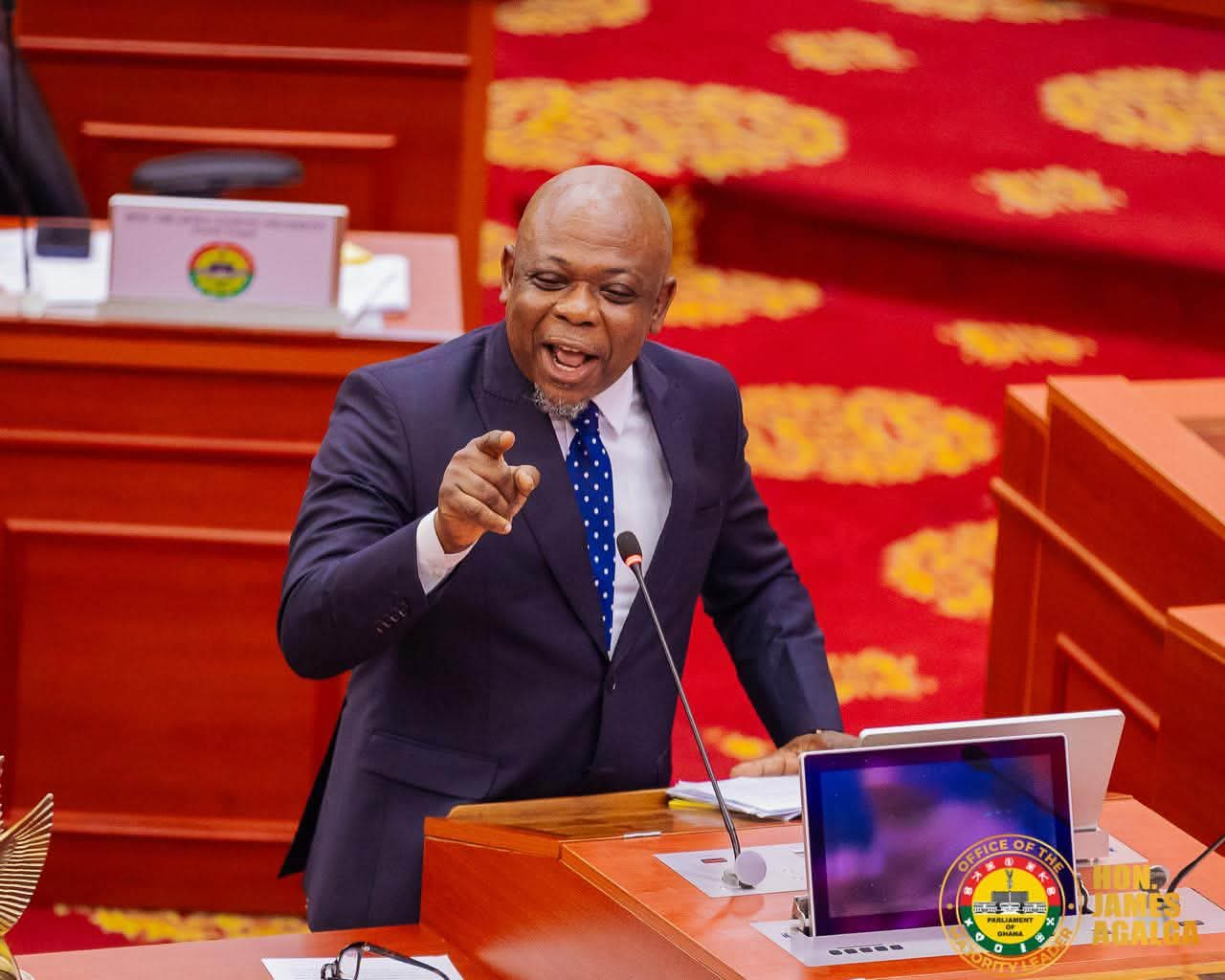
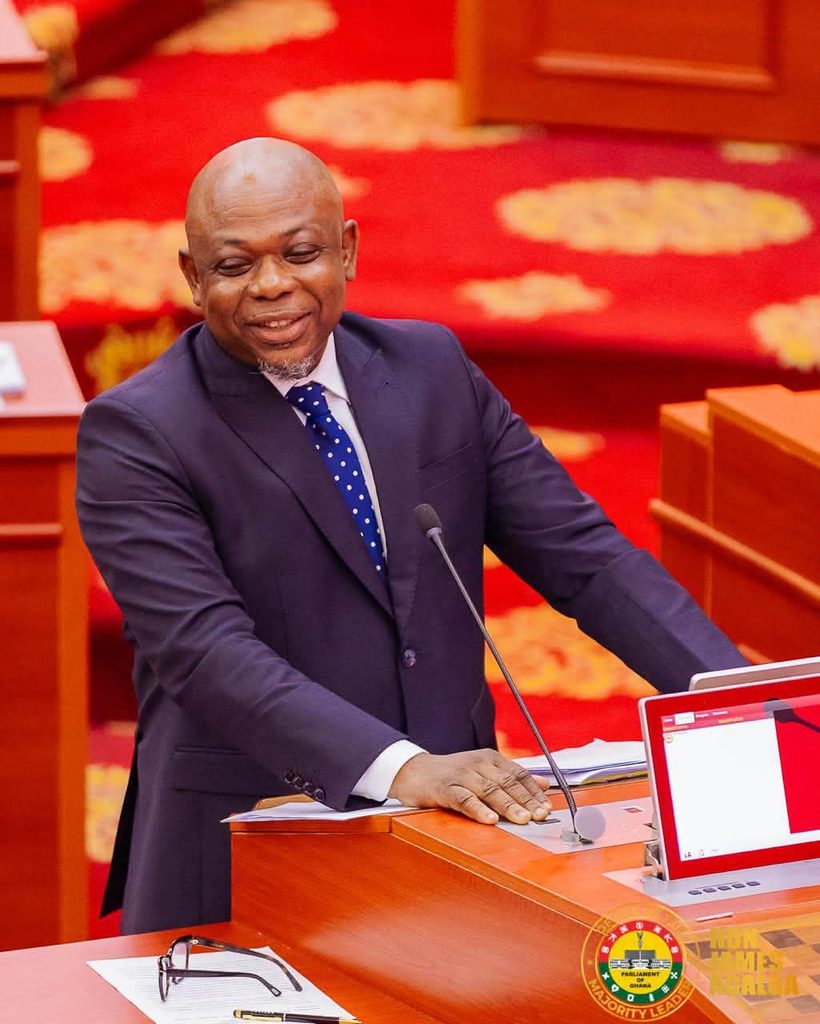
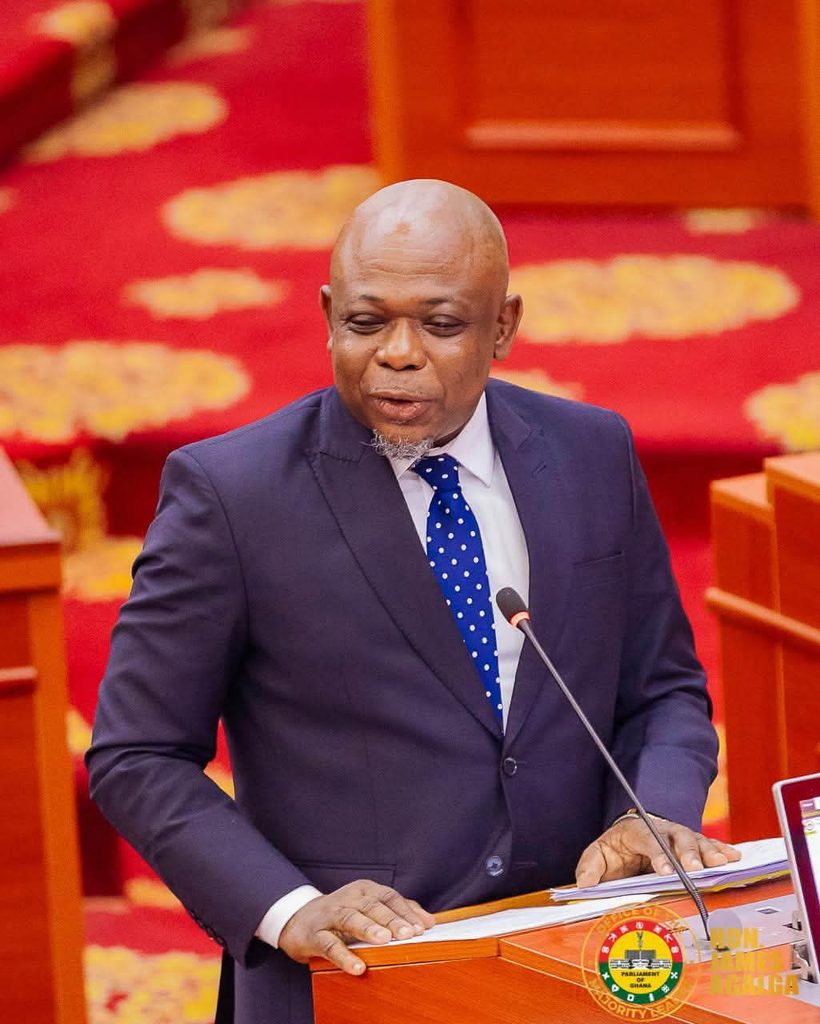
Majority Leader and Builsa North MP, Hon. James Agalga, has offered a forceful defence of the government’s 2027 Budget, arguing that Ghana’s economic trajectory has fundamentally changed over the past two years and that the clearest evidence lies not in political rhetoric but in the country’s economic indicators.
Concluding the parliamentary debate on the budget, the Hon. Agalga framed the central question confronting the House in simple terms: “Is Ghana better off than it was two years ago?”
His answer was unequivocal: Ghana is on the right road.
But beneath the political confidence of his submission was a broader argument about what the government believes should define economic recovery, not merely stabilising the macroeconomic numbers, but translating that stability into production, jobs, infrastructure and eventually improved household welfare.
From economic crisis to fiscal consolidation
Hon. Agalga pointed to a dramatic decline in inflation as one of the strongest indicators of the change in Ghana’s economic fortunes.
According to the figures he cited, headline inflation has fallen from 54.1 percent to 5.5 percent, while food inflation stood at 2.8 percent in October 2026, down from 8.7 percent.
He also cited a reduction in the fiscal deficit to 1.0 percent of GDP against a 3.0 percent target, a primary surplus of 1.4 percent of GDP and a reduction in public debt from 61.8 percent to 47.5 percent of GDP.
Foreign exchange reserves, he said, had risen to $12.7 billion, equivalent to 4.5 months of import cover, while the policy rate had declined from 18 percent to 11 percent.
The government has also undertaken what Agalga described as GH¢36 billion in early debt retirement.
For the Majority Leader, these figures are not merely accounting statistics. They represent an economy that, in his assessment, has moved from stabilisation toward recovery.
The upgrading of Ghana by international ratings agencies Fitch and Moody’s was presented as further external validation of that argument.
Yet the political challenge remains whether these macroeconomic improvements are being felt sufficiently by ordinary Ghanaians.
Agalga himself acknowledged that the recovery “has not reached every household yet.”
That admission may be one of the most important elements of his concluding argument. It recognises the gap between macroeconomic recovery and household experience — a gap that often determines whether economic statistics translate into political credibility.
From promises to production
The second pillar of Agalga’s defence is the government’s claim that economic recovery must ultimately be anchored in production.
He presented the New Economy Programme as the mechanism through which the government intends to move beyond what he characterised as promises and speeches.
The 2027 Budget, he said, commits GH¢30 billion to commercial agriculture, energy, textiles, pharmaceuticals and critical minerals.
Commercial agriculture alone is expected to receive $2.9 billion, with the government targeting 100,000 hectares of new rice hubs across the Afram Plains, Volta Basin, Western and Northern Regions.
The rice programme is projected to create 125,000 jobs.
A particularly significant policy shift is the planned requirement that public institutions begin purchasing Ghanaian rice from 2027.
If implemented effectively, the policy could create a guaranteed domestic market for local producers while reducing dependence on imported rice.
That, however, also places considerable pressure on domestic producers to meet standards of quality, volume, reliability and price.
Agalga’s broader argument is that government spending should create productive capacity rather than merely finance consumption.
His reference to the poultry sector reinforces that position. He cited a 22 percent increase in poultry production under the Nkoko Nkitinkiti programme and said the Bechem factory was 50 percent complete.
Agriculture becomes the government’s economic test
Agriculture appears to be one of the clearest arenas in which the government intends to demonstrate that its production-centred approach is different from previous programmes.
Agalga contrasted the current government’s plans with what he described as the previous administration’s commissioning of the Pwalugu project without corresponding irrigation development.
Under the 2027 Budget, he said, $1 billion has been allocated to the Pwalugu Dam, with the first phase expected by 2029.
Other projects include the 500-acre Aninkroma Irrigation Project in the Ashanti Region and the 175-hectare Anunuso Water Conservation Scheme intended to support rice production.
The underlying policy logic is clear: irrigation, water conservation, processing and guaranteed markets are expected to make agriculture more commercially viable and less vulnerable to rainfall patterns.
The success of that strategy, however, will ultimately be measured not by allocations in the budget but by hectares actually cultivated, factories actually operating, farmers actually producing and jobs actually created.
Education: unfinished projects become a political fault line
Education formed another part of Agalga’s argument.
He said the government plans to complete 30 Community Day Senior High Schools, while GETFund interventions will cover 200 Junior High Schools, 200 primary schools and 200 kindergartens.
The programme is also expected to include teachers’ bungalows, sanitation facilities, textbooks and furniture.
Agalga’s formulation was deliberately political: a school without a teacher, he argued, amounts to a monumental failure.
The point goes beyond physical infrastructure. The government is attempting to present education investment as a combination of buildings, teachers and the basic resources required to make those buildings functional.
That distinction matters in a country where political debate has often focused heavily on the number of projects commissioned rather than whether they are fully operational.
The digital economy as a new growth frontier
Agalga also highlighted Ghana’s rapidly expanding digital financial ecosystem.
He cited a 32.61 percent increase in GhIPSS transactions, transaction values exceeding GH¢1 trillion within half a year, 26.7 million active mobile money accounts and more than 200 fintech companies.
These figures point to a different dimension of Ghana’s economic transformation — one less dependent on physical infrastructure and increasingly driven by digital payments, financial technology and electronic commerce.
The challenge for government will be to convert that digital expansion into broader productivity gains, particularly for young people and small businesses.
The presidential jet controversy
Agalga also sought to neutralise one of the politically contentious issues surrounding the budget: the proposed presidential jet.
His argument was that the decision was not a unilateral government undertaking.
According to him, both sides of the House approved the acquisition without objection. He further argued that the existing aircraft, which is 16 years old, had been grounded in France for months in 2025 and that the replacement was financed from Ghana’s own resources rather than through borrowing.
The issue is likely to remain politically contested despite the Majority’s explanation, because the debate surrounding the aircraft is not simply about its financing. It also concerns competing perceptions of public expenditure at a time when households continue to confront economic pressures.
The deeper political argument
At the heart of Agalga’s concluding remarks is a contest over what constitutes economic progress.
For the Majority, the government’s case is that Ghana has moved beyond crisis management. Lower inflation, reduced debt, stronger reserves, fiscal consolidation and declining interest rates are presented as the foundation upon which a production economy can now be built.
The opposition’s likely counterargument is that macroeconomic stability means little to citizens who remain unemployed, struggle with purchasing power or cannot directly see the benefits of the recovery.
That tension is unlikely to disappear with the passage of the budget.
Indeed, it may become the defining political question of the next phase of the government’s tenure: Can macroeconomic recovery be converted into visible improvements in household welfare?
Agalga does not claim that the journey is complete.
Instead, he argues that the direction has changed.
His closing question was therefore less about whether Ghana had already arrived at its desired economic destination and more about whether the country was travelling in the right direction.
His answer was clear: “And we are.”
The 2027 Budget will now have to prove that assertion not only on the floor of Parliament, but in farms, factories, classrooms, businesses and households across Ghana.
 Zakaria Rafique Seinu