
 By Zakaria Rafique Seinu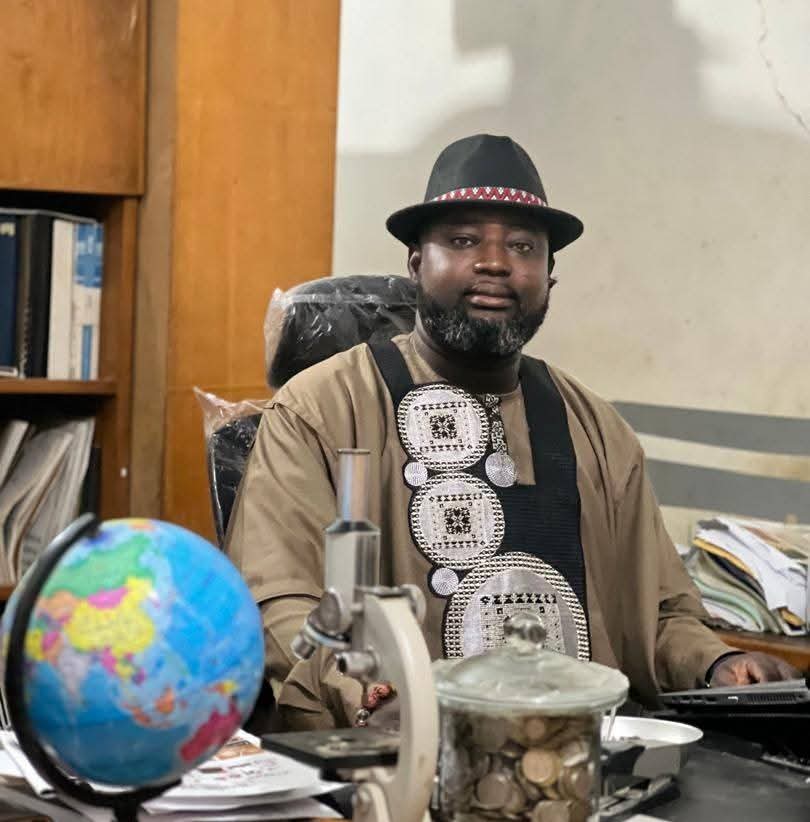
In classrooms across Ghana, science is often taught in English. The textbooks are in English. The exams are in English. But the language students speak at home, argue with siblings in, and dream in is often something else entirely. For thousands of young people in the Upper West Region, that language is Waali. Zakaria Osman Froko saw that gap, and he decided to close it one TikTok video at a time.
Zakaria is a science lecturer at Nasrat Jahan Ahmadiyya College of Education in Wa, Upper West Region. On paper, that is already a demanding job. COE lecturers train the next generation of basic school teachers, which means the quality of their teaching ripples out to hundreds of classrooms later. But Zakaria added a second classroom, this one on TikTok, where he hosts a programme dedicated to teaching science concepts in Waali. It is simple, direct, and it is working.
Ghana is multilingual. Over 80 languages are spoken. In schools, English is the official medium of instruction from upper primary upwards. The intention is clear: give students access to global knowledge. The reality is also clear: if a child does not fully understand the language of instruction, the concepts get lost. Think about trying to learn “photosynthesis” or “Newton’s third law” when you are still translating every other word in your head. You end up memorizing definitions without grasping the meaning. Waali is spoken by a large community in Wa and surrounding areas. It is the language of the market, of family meetings, of radio. When Zakaria explains “force” as something you use to push a grinding stone, or describes the water cycle using examples from local wells and rainy seasons, the abstract becomes concrete. Students stop decoding language and start decoding science. That shift is huge. Research in education has consistently shown that students learn better when they are taught in a language they are proficient in, especially in foundational years. Zakaria is extending that principle to senior high and teacher training level, and using social media to scale it.
Nasrat Jahan Ahmadiyya College of Education in Wa has a long history of training teachers for basic schools. As a science lecturer there, Zakaria spends his days preparing lesson plans, demonstrating experiments, and mentoring student teachers who will go on to teach in communities across the north. But he noticed something outside the lecture hall. Students were on TikTok. They were learning dance trends, comedy skits, and life hacks in 60 seconds. Why not science? So he started a programme on TikTok. No big studio. No expensive equipment. Just Zakaria, a whiteboard or a simple demonstration, and Waali. The format is practical. A concept gets broken down in a few minutes. He might start with a question in Waali: “Ba na a ma bulee ka baara?” meaning “What makes a ball roll?” Then he walks through friction, force, and motion, using examples students see every day: pushing a wheelbarrow, riding a bicycle on a dusty road, fetching water. He uses analogies rooted in Upper West life. Chemical reactions become like mixing ingredients for tuo zaafi. States of matter are explained with shea butter, water, and smoke from cooking fires. Electricity is tied to solar panels and torch batteries that many homes rely on. The tone is not formal. It is conversational, like an elder explaining something under a tree. Viewers comment with questions, and he responds in the next video. That feedback loop makes it feel less like a broadcast and more like a class.
This is where Zakaria really shines. Topics that usually confuse students become clear when he teaches them in Waali. Take MATTER. In English textbooks it’s defined as “anything that has mass and occupies space.” For many students that sounds abstract. But Zakaria reframes it. In Waali he explains: “Matter ka a yi neŋ eŋa neŋ ka a na nɔ so, nɔ nya, bee nɔ tɔ” — anything that has weight and takes up space. Then he brings it home. Solid is shea nut, stone, desk in class. Liquid is water from the borehole, cooking oil. Gas is smoke from firewood, the air we breathe. Suddenly students aren’t memorizing. They are pointing at things around them. He does the same with other important topics. Force and Motion becomes pushing a wheelbarrow to the market, riding a bike on a dusty Wa road. Acids and Bases are explained with tamarind for sourness, soap and ash water for bases. Energy is tied to solar panels on rooftops, firewood for cooking, grinding machines. The Water Cycle is taught through rainfall in the wet season, evaporation under the Wa sun, and water in dams. By grounding each concept in everyday Upper West experiences, he removes the fear around science. Students begin to see that science is not something foreign. It is already in their kitchens, farms, and streets.
It is not as easy as just translating English terms. Many scientific words do not have direct Waali equivalents. Zakaria has to do two things at once: explain the concept, and build the vocabulary around it. Sometimes he coins a descriptive phrase. Sometimes he keeps the English term but explains it thoroughly in Waali so students can link both. Over time, this creates a bilingual science vocabulary for his audience. There is also the challenge of resources. Filming consistent content while lecturing full time is a lot. Data is expensive. Internet connectivity in parts of Wa can be unstable. And TikTok’s algorithm does not always favor educational content over entertainment. Yet he keeps going because the comments and DMs tell him it matters. Student teachers send messages saying they used his explanation in their teaching practice. Junior high students say they finally understood acids and bases. Parents say their children now explain things to them at home.
Ghana’s education policy has been moving toward mother-tongue instruction in the early years, but implementation is uneven and resources in local languages are limited, especially for science. Most science content online is still in English, French, or other global languages. Zakaria’s TikTok programme fills a specific gap. It is free, on-demand, and in a language that many students are most comfortable with. It does not require a new textbook or a policy change. It just requires a phone. It also models something important for his student teachers at the COE. When they see their lecturer creating accessible content, they learn that teaching is not just about covering a syllabus. It is about meeting learners where they are. Many of them will go to teach in rural schools where English proficiency is low. Having seen Waali science teaching modeled, they are more likely to try it themselves. This is how systemic change starts. Not always with a big reform, but with one teacher deciding to speak the language of his students.
Beyond the immediate lessons, Zakaria is doing cultural work. He is showing that Waali is not “just” for home. It is a language capable of discussing atoms, energy, and the environment. That matters for language pride and for children’s confidence. When a child hears science in their mother tongue, the message is: your language is smart enough for this. Your background is not a barrier. You belong in STEM. There is also a community-building effect. TikTok allows people from Wa living in Accra, Kumasi, or even abroad to reconnect with home and learn at the same time. A student in Accra can send a video to a younger sibling in Wa. A teacher can save videos to use in class. The programme is also an example for other educators. What if there were TikTok teachers doing math in Dagbani, biology in Ewe, or physics in Ga? The tools are already in everyone’s pocket.
Three things make Zakaria’s approach work. First is relevance. He does not teach abstract examples from a foreign textbook. He teaches with local materials and local problems. Water purification, soil types, simple machines on farms. Second is clarity. He avoids jargon. If he must use a technical term, he defines it and repeats it. Short videos mean one idea at a time. Third is consistency. Showing up regularly builds trust. Students know they can come back for the next topic. He is not trying to replace the classroom. He is supplementing it. He is creating a revision tool, a bridge, and sometimes the first time a student actually “gets” a concept.
The potential is large. With more support, the TikTok programme could grow into a library of Waali science videos organized by topic and level. That library could be used by teachers, shared via WhatsApp groups, and played in classrooms with projectors. There are also opportunities for collaboration. NGOs working on education in northern Ghana, COE leadership, and even the Ghana Education Service could partner to provide data bundles, better recording equipment, or curriculum alignment. But even without that, the work is already valuable. One lecturer, one phone, one language. That is enough to start changing how a student sees science. Zakaria Osman Froko is not just teaching science. He is translating opportunity. By taking Newton’s laws, chemical equations, and even something as basic as MATTER, and putting them into Waali, he is removing one of the biggest barriers to learning: language. He is proving that quality science education does not have to wait for new policies or big budgets. It can start with a teacher who understands his students and a platform where they already are. In Wa, in the Upper West Region, and now on TikTok feeds across the country, science is being spoken in a voice that sounds like home. And for many learners, that makes all the difference.
 Ishmael Junourgh