
 By Zakaria Rafique Seinu
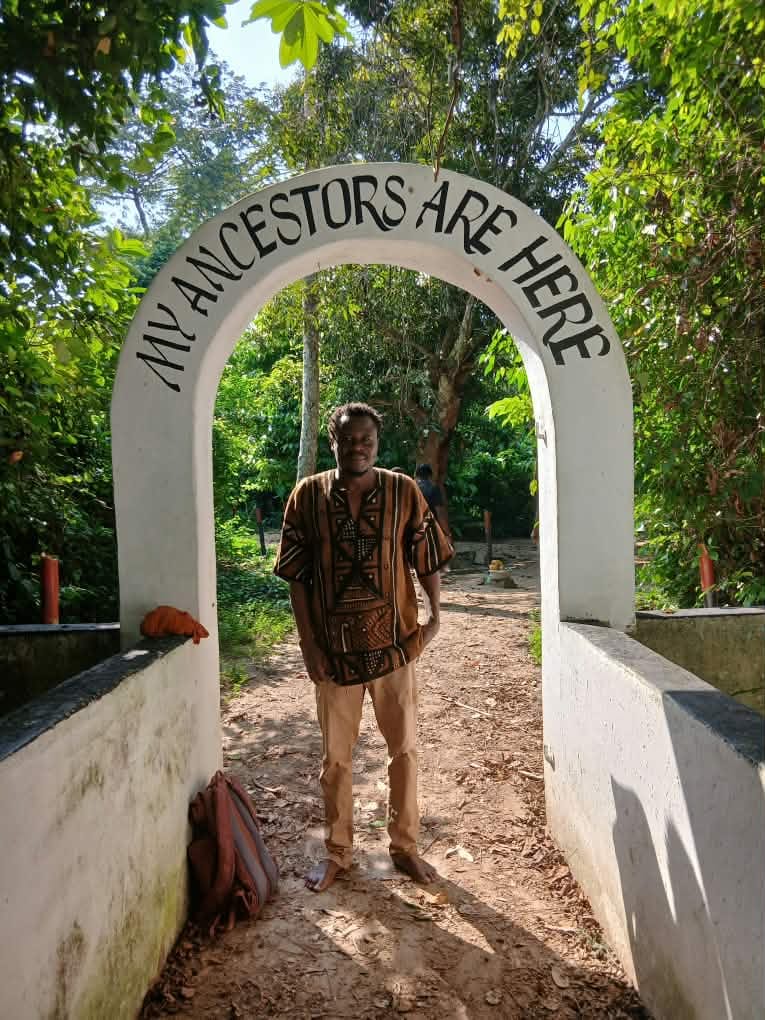
There are writers, and then there are writers who live.
Many authors the world over are far apart from the world of the novel. They sit in quiet rooms, far from the people they write about, far from the soil, far from the smell of the rain, far from the sound of the drum. They imagine Africa. They do not live Africa.
Ismael Junuorgh is not one of them.
Junuorgh understands the gap between the writer and the story, and he goes the extra mile to close it. He does not just write his books. He walks into them. He wears them. He breathes them. He brings to life the settings, the themes, the motifs and the costumes that define his works, because for him, a novel is not a thing you finish and put on a shelf. It is a life you enter.
He is the author of LADIMEH, a story of an abandoned African slave. And now, LADIMEH IS BACK HOME.
That sentence alone carries weight. Because Ladimeh is not just a character on a page. Ladimeh is us. Ladimeh is the child who was taken, the name that was lost, the story that was buried, the voice that was silenced. Ladimeh is the African who was abandoned by history, but who refused to die in our memory. To say Ladimeh is back home is to say that our story has returned to where it belongs — to our soil, to our people, to our own mouths.
And Junuorgh is the man who brought him home.
To search for Junuorgh, you must not look for him in a library alone. You must look for him where his story lives. Look at him. Look at the picture that has been going round. He is standing barefoot under the arch at Assin Manso, where it is written in bold letters: MY ANCESTORS ARE HERE. He is not posing for a tourist photo. He is not acting. He is standing where his ancestors stood. He is wearing the cloth of his people. His feet are touching the same earth they touched. His eyes are calm, but they are carrying history.
That is Junuorgh. He tells our story by living it.
He is not detached from his roots. He does not run away from who he is in order to be accepted by the world. He goes deeper into who he is, so that the world will have no choice but to come and meet him there. He is a griot whose style can be visualized in him. You do not need to open his book to know what kind of writer he is. Just look at how he dresses. Listen to how he speaks. Watch where he goes. Watch how he stands. The man himself is the story.
In Africa, we have always known the griot. The griot is not just a storyteller. The griot is the memory of the people. He is the one who remembers what others have forgotten. He is the one who carries the names, the proverbs, the songs, the wars, the victories, the pains. He does not write from outside. He speaks from inside. Junuorgh is that griot for our time. His style is not borrowed. His style is lived. You can see it in him.
What does he do that makes him different? Let us be plain about it.
1. He speaks truth in his novels.
Junuorgh does not write to please. He does not write to make the story sweet for those who do not want to hear the bitter part. He speaks truth. The truth about slavery. The truth about abandonment. The truth about what was done to us, and what we did to ourselves. The truth about pain, but also the truth about strength. In his novels, you will not find a watered-down Africa. You will find Africa as she is — beautiful, wounded, proud, and still standing.
2. He writes about things that can be traced and verified.
This is very important. There are many stories about Africa that are just imagination. Beautiful imagination, but imagination all the same. Junuorgh is different. What he writes, you can go and check. You can go to Assin Manso and see the river where our ancestors took their last bath. You can see the arch. You can see the chains. You can touch the trees. You can ask the elders. You can open the history books. His fiction stands on facts. His imagination stands on evidence. That is why when you read him, you do not just feel entertained. You feel educated. You feel grounded.
3. He lives his work.
This is the part that separates him from so many others. Many writers write about the village, but they never go to the village. They write about the smock, but they never wear the smock. They write about the slave, but they never stand where the slave stood.
Junuorgh lives his work. If he writes about the slave route, he walks the slave route. If he writes about the costume, he wears the costume. If he writes about the forest, he enters the forest. If he writes about the ancestors, he goes to meet the ancestors. That is why his writing has blood in it. It is not cold. It is warm. It is alive.
4. His stories are grounded in African history, anthropology and sociology.
When you read Junuorgh, you are not just reading a story. You are reading a whole world. You are learning how our people lived, how they married, how they buried their dead, how they named their children, how they worshipped, how they fought, how they forgave. His stories are grounded in history, because he respects the past. They are grounded in anthropology, because he respects our culture. They are grounded in sociology, because he respects our people and how we live together. He does not treat Africa as a background. He treats Africa as a living being.
5. His stories are timeless.
Some books are for today, and tomorrow they are forgotten. Junuorgh’s books are not like that. The story of Ladimeh, the abandoned African slave, is not a story of yesterday alone. It is a story of today. It is a story of every African child who has been made to feel abandoned. It is a story of every African who has been made to feel that his name does not matter, his language does not matter, his skin does not matter. Ladimeh is timeless because abandonment is still happening. And homecoming is still needed. A hundred years from now, people will still read Ladimeh and they will still see themselves in him.
6. The African culture is well expressed in his story.
In Junuorgh’s work, culture is not decoration. It is not something he adds to make the book look African. Culture is the soul of the book. The food, the dress, the dance, the proverb, the drum, the respect for elders, the power of the community — all of it is there, and it is there correctly. He does not misrepresent us. He does not caricature us. He presents us as we are, with dignity. When a stranger reads his work, that stranger will learn what it truly means to be African. When an African reads his work, that African will feel proud to be African.
7. His advocacy for Afrocentric ideals is unmatched.
Junuorgh does not hide his position. He is Afrocentric, and he is proud of it. He believes that Africa must tell her own story, in her own voice, from her own centre. He believes that our history did not start with slavery, and it will not end with slavery. He believes that we have our own philosophy, our own beauty, our own way of seeing the world, and that way is valid. His advocacy is not just in his speeches. It is in every page he writes. It is in every step he takes. It is in every cloth he wears. It is unmatched because it is not performance. It is conviction.
Now, let the world watch out.
Watch out for Junuorgh, because he lives like a true African writer. He lives like Ngugi wa Thiong’o of Kenya.
Anyone who knows African literature knows what that means. Ngugi is not just a writer. Ngugi is a movement. Ngugi refused to let the colonial language be the only language of the African story. He went back to Gikuyu, his own mother tongue, because he understood that language is not just words — language is memory, language is soul, language is power.
Ngugi went to prison for his beliefs. He was exiled for his beliefs. But he never stopped. He never bent. He never sold his story to please others. He lived his writing, and his writing lived him.
That is the same spirit we see in Junuorgh.
Like Ngugi, Junuorgh does not write to impress the West. He writes to reclaim Africa. Like Ngugi, he believes that the African writer must be rooted. Like Ngugi, he believes that you cannot decolonize the mind if you are ashamed of your own feet, your own cloth, your own language, your own ancestors. Like Ngugi, he is willing to go to the places that others are afraid to go, to stand where history is painful, and to say: I am here. My ancestors are here. I have come home.
In a time when many African writers are trying to sound foreign in order to be accepted, Junuorgh is trying to sound African in order to be true. In a time when many are running away from the village, he is walking back to the village. In a time when many are embarrassed by the griot tradition, he is proudly becoming the griot.
That is why LADIMEH IS BACK HOME is not just a book announcement. It is a homecoming. It is a return. It is a statement. It is Junuorgh saying to the world: Our stories are not lost. Our people are not lost. We are here. We have always been here. And we are telling our own story now.
So, to the readers in Ghana, in Kenya, in Nigeria, in South Africa, in the diaspora, in America, in the Caribbean, in Europe — watch out.
Watch out for a writer who does not just write about the ancestors, but stands barefoot before them. Watch out for a writer who does not just describe the costume, but wears it with pride. Watch out for a writer who does not just imagine the slave route, but walks it with reverence.
In search of Ismael Junuorgh, you will find him where the story is still alive — in the village, in the forest, at the river, under the arch where it is written: MY ANCESTORS ARE HERE.
Because when a writer lives his work, his work will live forever. And Ladimeh has come home to stay.
 Charles Prempeh PhD
 The Bridge News
 Ishmael Junourgh