
 By Ishmael Junourgh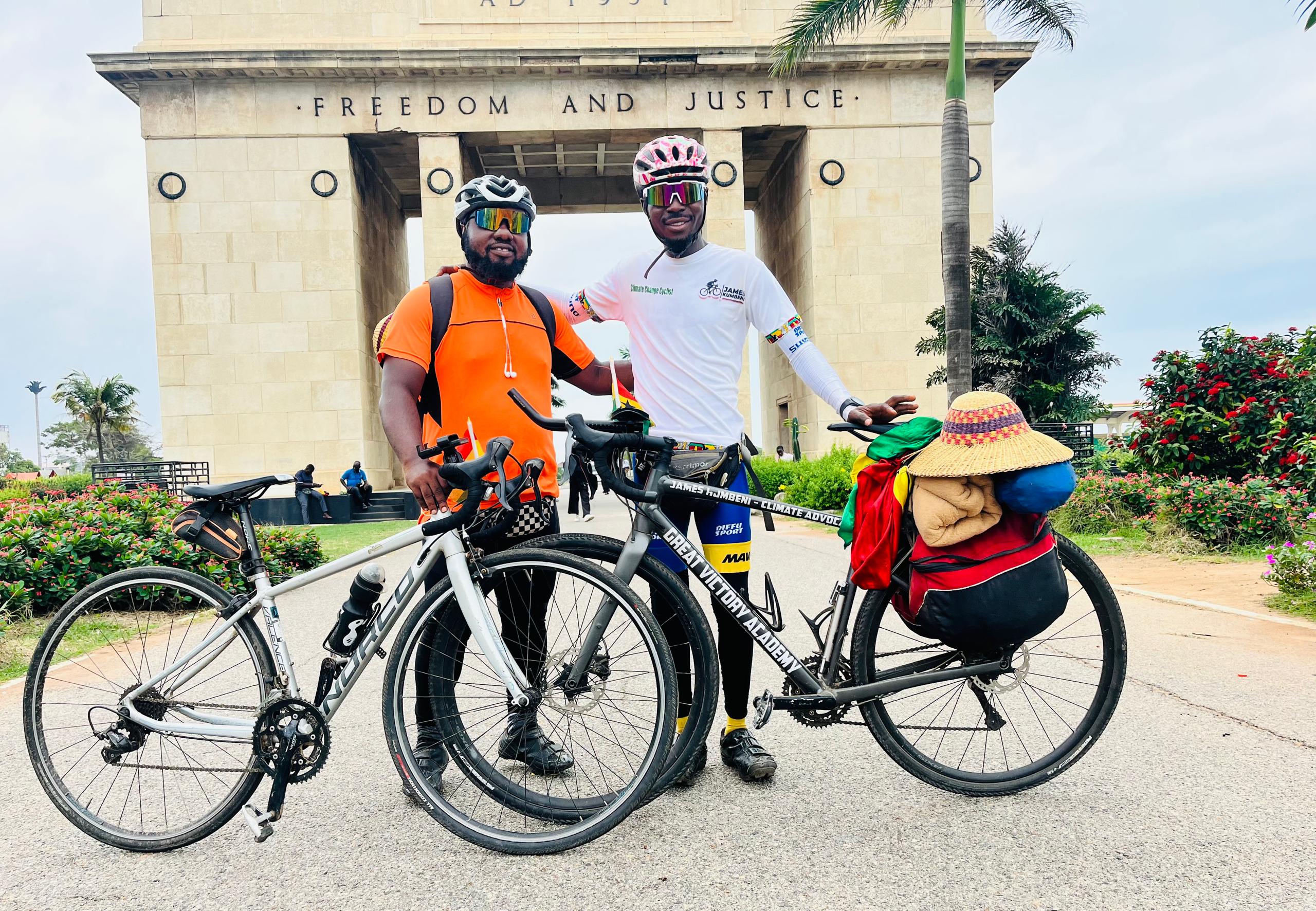
What began as a 1,497-kilometre cycling expedition across Ghana, Togo and Benin has evolve into a powerful call for sustainable climate action, cleaner energy and biodiversity conservation in West Africa.
The push to the front burner of climate action was occasioned after two of Ghana’s international cyclists, James Kumbene and Kingsley Ampong Adu, rode 1,497 kilometres from Ghana through Togo to Benin and back to their home country.
But many West African countries face financial constraints, weak enforcement, inadequate refinery infrastructure and the persistence of informal fuel markets in addressing the challenge of what is often referred to as “African-quality” fuels. The United Nations Environment Programme (UNEP) states that in 2020, West African ministers adopted cleaner fuel and vehicle standards in line with the ECOWAS directive, requiring 50 ppm sulphur fuels across West Africa from January 2021, with cleaner vehicle standards also adopted. Sadly, dirty fuels are still found at fuel pumps in many of these countries.
James Kumbene is an ardent climate advocate and cyclist from Bare in the Talensi District of the Upper East Region, while Kingsley Ampong Adu is a health educator based in Accra, the capital of Ghana. The cyclists spent a week pedalling through the three countries to prove a simple point: the bicycle is not a poor man’s means of transport. It is a weapon against the slow disaster building over the skies of the globe.
By travelling on bicycles, the duo reduced carbon dioxide emissions by about 812.26 kilograms compared to what would have been produced by a car journey covering the same distance. They returned with proof that individuals can play a meaningful role in the fight against climate change.
The duo left Bolgatanga, the capital of the Upper East Region of Ghana, on bicycles, passing through Walewale, Bunkpurugu and Nalerigu, the capital of the North East Region. From there, they entered northern Togo through Mango before crossing into Benin through the northern town of Boukoumbé. They continued southwards to Natitingou and finally arrived in Cotonou, the capital city of Benin, where they were received by officials of the Ghana Embassy.
On their return journey, they passed through Lomé and cycled directly to the Independence Square in Accra, covering a total distance of 1,497.11 kilometres.
Speaking with The Bridge News, Kumbene described himself first as an environmentalist, adding that for the past five years he had turned that commitment into action, spending more time on a bicycle than in front of cameras or at public events. He explained that they had built the campaign around a simple scientific fact: every journey made by bicycle is one that produces no direct carbon emissions.
The statistics supporting that statement are significant. Climate Analytics and the OECD’s Effective Carbon Rates report estimate that transportation accounts for approximately 17–21.6 per cent of Ghana’s total greenhouse gas emissions. With the increasing number of imported vehicles on the country’s roads, petrol and diesel transport contributes significantly to these emissions. The negative effects of climate change are recognised in Ghana’s National Transport Policy. Every kilometre ridden by Kumbene and other cyclists contributes to reducing the impact of the transport sector on the environment.
The impacts of vehicle emissions on human life extend beyond what climate data alone reveal. According to the World Health Organization Regional Office for Africa, approximately 383,000 people die annually from air pollution across the continent, with many of those deaths linked to emissions from transportation and industrial activities. Researchers writing in The Lancet Planetary Health found that fine particulate matter concentrations in Ghana remain extremely high, placing the country among those with some of the highest levels of air pollution in the world, above the WHO safety guideline. The cyclists are therefore not only reducing carbon emissions but also helping to protect the lungs of their fellow citizens.
Kingsley Ampong Adu, on his part, said the expedition had significantly improved both his emotional and physical health. He added that he thoroughly enjoyed the ride, aside from the environmental benefits of leaving no trace of pollution.
When asked about the strangest experience of the expedition, he pointed to an unexpected encounter deep in the remote bush of northern Togo.
“The harshest lesson came after Google Maps led us deep into the bush for more than three hours. There were no houses anywhere. Eventually, we reached a small community where the people had never seen a bicycle before.”
The cyclist continued: “They did not speak French or English, only their local language. Many of them, both adults and children, wore no modern clothing. They were just as surprised to see us as we were to see them. Frightened, the villagers alerted the police, who came for us, escorted us to their station for further interrogation, and later directed us to a safer route.”
He said the villagers offered them water as a gesture of kindness, which they knew would have been culturally inappropriate to refuse. They feared drinking it, yet they also understood that refusing could offend their hosts. For the duo, climate activism without human connection remains theoretical. Advocacy that shares water with strangers in the bush becomes something much closer to solidarity.
Kumbene said the contrast was immediately obvious once they crossed into Benin.
“Many people outside the country associate Cotonou with folklore and superstition, but what we saw was completely different,” he said. “The city was clean, construction was taking place everywhere, and there were dedicated bicycle lanes. It was hard not to compare it with Accra.”
He said riding through Cotonou convinced him that the city could become a major tourist destination if it continued on its current path.
“Look at what Dubai achieved through years of planning and investment,” he said. “Cotonou has that kind of potential.”
He added that cycling and physical activity have become part of everyday life in Benin, with the city’s investment in bicycle infrastructure demonstrating that a West African capital can build streets that safely accommodate cyclists alongside other road users.
Ghana has not made the same commitment, and cyclists feel the difference every day. Kingsley said riding through Accra often feels unsafe, not because the roads are impossible to use, but because many drivers behave as though cyclists have no right to be there. The greatest challenge, he argued, is not the roads themselves but the attitude of those who use them.
He and Kumbene were clear about one thing. They are not asking for special treatment. Like thousands of Ghanaians, they work, support their families and move around the city every day. They have simply chosen a form of transport that benefits their health and reduces pollution. What they seek is a road culture that recognises cyclists as legitimate road users, supported by policies that make sharing the road safer for everyone.
The journey challenged not only their legs and lungs but also tested their determination. Neither cyclist was fluent in French, so they relied on translators after crossing into Benin from Togo. Bicycle tubes were repeatedly punctured, and tyre repairs often consumed valuable hours. Both men were exhausted by the mountainous terrain of northern Benin. At the Togolese border, officials insisted on payment for exit stamps before allowing them to proceed, a practice that contradicts the ECOWAS protocol on the free movement of persons within member states.
Kumbene said mental discipline, rather than physical fitness, was what ultimately carried them through. The road was long and often empty, and there were moments when the only option seemed to be to keep pedalling. Without a riding partner offering encouragement at every kilometre, he admitted he might have given up much earlier. No one, he reflected, travels across three countries alone without learning something about endurance, resilience and the remarkable human capacity to persevere under the bicycle saddle.
Kumbene spends much of his own money supporting this cause, with only modest assistance from individuals inspired by his work. He receives no financial backing from government or corporate sponsors, creating an uncomfortable contradiction for a nation that has committed under its Nationally Determined Contributions (NDCs) to the Paris Agreement to reduce greenhouse gas emissions by 15 per cent by 2030. Ghana’s commitment to expanding low-carbon transport exists on paper. These two cyclists are putting that commitment into practice without a single cedi of institutional support.
This campaign carries special significance for northern Ghana. The Savannah and Upper East Regions continue to experience erratic rainfall, prolonged dry spells and the growing threat of desertification, all of which scientists have linked to global warming. Climate change does not affect a farmer in Bolgatanga or Damongo as an abstract statistic. It is experienced through failed harvests and lost planting seasons. Every kilogramme of carbon saved through cycling in Accra, Togo or Benin represents a small but meaningful contribution to reducing the warming that increasingly threatens livelihoods across the Savannah Belt. The cyclists returned with evidence that ordinary people, even without government support, can measure the impact of their actions, make their communities cleaner and give human meaning to a crisis too often reduced to graphs and international summits. Ghana can build bicycle lanes. Cyclists can safely share the roads with motorists. Government can support citizens who are already advancing the country’s climate goals through their own initiative. These two riders have demonstrated what is possible from the saddle. Their journey now leaves the country with a question: will Ghana build the roads that allow others to follow?