
 By Zakaria Rafique Seinu
DAR ES SALAAM, TANZANIA
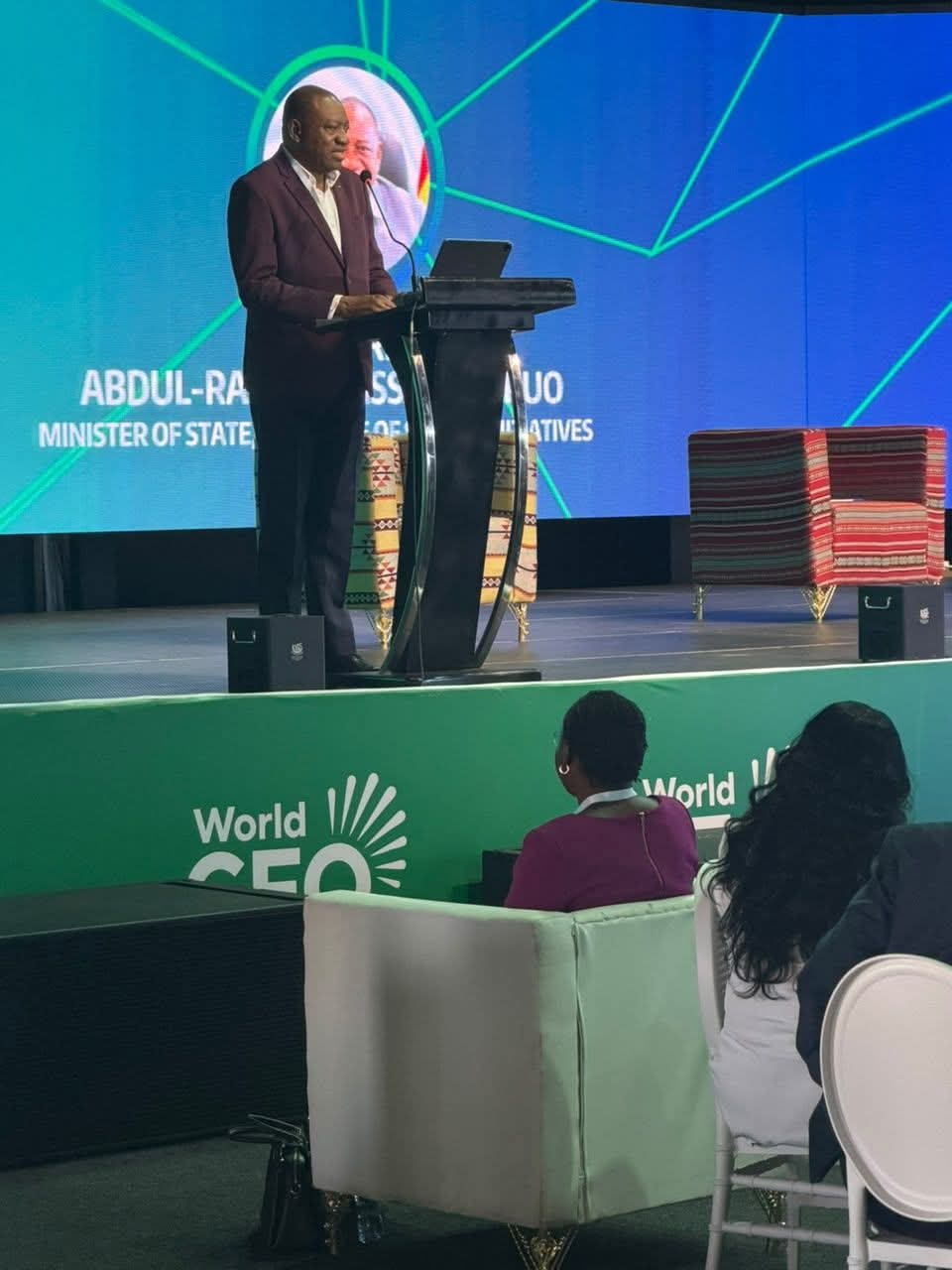
When the lights came up in the conference hall in Tanzania and the master of ceremonies called Ghana to the stage, it was not just a minister who stood up. It was a story, 21 years in the making, that stood up with him.
Hon. Dr. Abdul-Rashid Hassan Pelpuo, Ghana’s Minister of State in charge of Special Initiatives and Member of Parliament for Wa Central, addressed the CEO Summit and accepted an award on behalf of His Excellency President John Dramani Mahama.
It was a moment of national pride. But for those who know Pelpuo, it was also a moment of continuity. The man who spoke about local processing, about AfCFTA, about Ghana-Tanzania cooperation in agriculture, energy and mineral processing, was not delivering a speech written for a summit. He was delivering a philosophy he has carried from Wa to Accra, and from Accra to the world.
This is the story behind that speech, and what it means for Wa Central.
THE SPEECH THAT STOPPED THE ROOM
The CEO Summit, a two-day Global Edition programme featuring executive panels, investment dialogues, business matchmaking and the World CEO Awards, brought together chief executives, investors, government officials and development partners from across Africa and beyond.
In that room, Pelpuo did not speak in abstractions. He spoke in verbs: process, trade, build, execute.
His central argument was simple and urgent: Africa must stop exporting its wealth in raw form and importing it back as finished poverty.
He called for local raw material processing, for Ghana’s gold, cocoa, shea, manganese, bauxite and lithium to create jobs in Ghana before they create wealth elsewhere. He called for the full execution of the African Continental Free Trade Area (AfCFTA), not as a signed document in Addis Ababa or Accra, but as trucks crossing borders, factories receiving orders, and young entrepreneurs selling across a market of 1.4 billion people.
And he called for closer Ghana-Tanzania cooperation in agriculture, energy and mineral processing, two countries, one East and one West, bound by a shared Pan-African history and a shared economic future.
Africa must process what it produces, trade what it makes, and build what it needs, he told the summit.
It was a line that captured the room because it captured the continent’s dilemma in one sentence.
WHY THIS MINISTER, WHY THIS MOMENT?
To understand why President Mahama entrusted Pelpuo with that stage, you must understand what Special Initiatives means in this government.
On 26 August 2026, President Mahama reassigned Dr. Pelpuo from the Ministry of Labour, Jobs and Employment to the Office of the President as Minister of State in charge of Special Initiatives.
It was not a demotion. It was a move closer to the centre of power.
Speaking later on JoyNews’ The Pulse, Pelpuo explained the mandate in his own words: He sent me to the Presidency in charge of his policy initiatives, enabling me to look at all the initiatives that are coming out around to see which of them respond more adequately to the Reset Agenda which we have set in motion.
In other words, his job is to scan Ghana, and the world, for ideas that work, test them against the government’s Reset Agenda, adopt the best, develop them, and make them useful to the public.
That is why Tanzania mattered. The CEO Summit is not just a talk shop. It is a marketplace of initiatives. Pelpuo went there as Ghana’s chief scout for workable ideas, and as Ghana’s chief salesman for Ghanaian opportunity.
When he accepted the award on behalf of President Mahama, he was accepting it not as a personal honour, but as a recognition of a national direction: Ghana is back at the table, not begging for aid, but negotiating partnerships.
FROM LABOUR MINISTER TO PRESIDENCY: A RECORD OF DELIVERY
Pelpuo did not arrive at the Presidency empty-handed. His time as Minister for Labour, Jobs and Employment, from February 2025 until the August 2026 reshuffle, left a measurable footprint.
He confronted a stark reality head-on. Speaking at the Design and Technology Institute’s Jobs and Opportunities Fair in July 2025, he revealed that nearly 60 percent of the 300,000 young graduates entering Ghana’s labour market each year remain unemployed, underemployed or without the relevant skills for available jobs.
His response was not rhetoric. It was programmes.
He championed the government’s commitment to create two million dignified jobs by 2028. He pushed technical training, entrepreneurship, and stronger academia-industry collaboration.
He signed a Memorandum of Understanding with Dominion Leaders Foundation, German BFW and RETOG to equip youth with skills for local and international job markets. That partnership became the ROCET Project, which provides opportunity for 30 qualified Ghanaians aged 18 to 30 to go to Germany every year for a three-year skills training and employment programme.
He also launched, with the Youth Employment Agency, the Ghana Work Abroad Programme, a legal, safe pathway for Ghanaian talent in artisanship, hospitality, transportation, agriculture and construction.
On the domestic front, he pushed the National Workplace Compliance and Safety Management System (NWCSMS) to move labour inspection from a manual, paper-based system to an integrated, data-driven, risk-based digital platform.
He also declared results for three Child Labour Free Zones in Ashanti and Western North, presenting community-led action as proof that Ghana can eliminate child labour.
WHAT HE IS DOING NOW AT SPECIAL INITIATIVES
Since moving to the Presidency, Pelpuo has wasted no time in showing what Special Initiatives can do when it is properly focused.
The clearest example is energy safety, an issue that touches every kitchen in Ghana.
In November 2026, the Ministry of Special Initiatives engaged stakeholders on the ATOM Explosion Prevention System (AEPS) to improve safety in the use of liquefied petroleum gas (LPG) in homes, schools and commercial kitchens. The technology forms part of the Regional Energy Sustainability Programme (RESP), coordinated by the Presidential Special Initiatives in collaboration with Premium Pole Investments Limited.
Pelpuo did not present it as a safety gadget alone. He presented it as industrial policy, local manufacturing, thousands of technical jobs for young people, and positioning Ghana as an export centre for the technology across West Africa under AfCFTA.
This is Pelpuo’s method: take a safety problem, turn it into a manufacturing opportunity, turn that into jobs, turn those jobs into exports, and turn those exports into climate finance. That is what Special Initiatives means in practice.
It is the same logic he took to Tanzania: process locally, trade continentally, build sustainably.
THE LONG ROAD FROM WA: SIX TERMS OF SERVICE
Pelpuo was born on 15 May 1964 in Wa. He holds a diploma in Economics, a degree in Psychology, a Master’s in International Affairs, and a PhD in Development Policy from the University of Ghana.
He entered Parliament in 2005 after winning the Wa Central seat in the 2004 election. He has since been re-elected continuously, serving a sixth term in the 9th Parliament, a record of trust few Ghanaian politicians can match.
He has served as Minister for Youth and Sports, Minister of State at the Office of the President in charge of Private Sector Development and Public-Private Partnership, Deputy Majority Leader, and Ranking Member of the Government Assurance Committee.
A man who once held government to account for its promises now sits at the Presidency deciding which promises are worth keeping and scaling.
WHAT DOES THIS MEAN FOR WA CENTRAL? A CITIZEN’S GUIDE
For constituents in Wa Central, the question is fair: What does a speech in Tanzania do for a farmer in Busa, a trader in Wa Market, a student in Bamahu, or a nurse in Dokpong?
First, Special Initiatives is a gateway, not a backwater. Because Pelpuo sits at the Presidency, he can bring national pilot programmes to Wa first.
Second, AfCFTA execution means markets for Upper West produce. When Pelpuo talks about processing raw materials locally, he is talking about shea butter in Wa, not just cocoa in Kumasi.
Third, Ghana-Tanzania cooperation is a template for Wa. Cooperation means shared technology, joint ventures, and lessons on how mineral wealth can fund local development rather than leave communities poor.
Fourth, his constituency record shows he converts national access into local delivery. Between January and September 2025 alone, his office reported GHS335,611.13 in support to 150 tertiary students, GETFund scholarships for 11 university students, a BECE mock examination, a three-unit classroom block for Wa Model School through GNPC, desktop computers and cadet uniforms for Wa Senior High Technical School and Wa Islamic Girls SHS, four new boreholes and rehabilitation of 13 boreholes, and support to petty traders and sports.
Fifth, jobs are the bridge. The programmes he built at Labour, ROCET, Work Abroad, the 2 million jobs target, are not abstract. For a young person in Wa Central, a German vocational placement or a safe work-abroad pathway can change a family’s trajectory.
WHY THE WORLD LISTENED
Ghana hosts the AfCFTA Secretariat in Accra. When Ghana speaks about AfCFTA execution, the world listens because Ghana is not just a member, it is the home of the institution.
That is why the Tanzania speech matters beyond applause. It signals that Ghana intends to use its host status to push implementation, not just host meetings.
THE CHALLENGE AHEAD
AfCFTA execution has been slow across the continent. Non-tariff barriers, poor roads, customs delays, and lack of industrial capacity still frustrate traders. Local processing requires electricity, capital, and skills, all scarce in regions like the Upper West.
The test of the Tanzania speech will not be in Dar es Salaam. It will be in Wa: Will a shea processing plant open? Will a technical training centre link to the ATOM plant? Will a Wa entrepreneur sell processed goods to Tanzania under AfCFTA?
CONCLUSION: A SON OF WA, A VOICE FOR AFRICA
When Dr. Rashid Hassan Pelpuo stood in Tanzania and spoke for Ghana, he carried Wa with him.
He told the world that Africa’s future is not in exporting raw materials and importing finished goods. It is in processing, trading and building, at home, by Africans, for Africans.
For Wa Central, the message is both a promise and an invitation: the man you sent to Parliament 21 years ago now sits at the Presidency, scanning the world for initiatives that can work for you.
Because if the Reset Agenda is to mean anything, it must mean something in Wa Central first.
And on that day in Tanzania, Wa Central was not on the margins of Ghana’s story. It was at its centre, speaking to the world.
 Ishmael Junourgh
 Prof. Damasus Tuurosong