
 By Zakaria Rafique Seinu
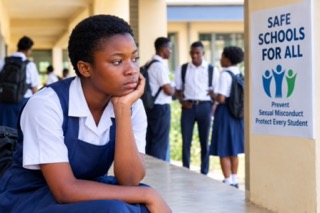
We need to tell ourselves the truth in Ghana.
When we hear “sexual misconduct in schools,” our minds go to one place only: a male teacher and a female student. We have built our entire conversation, our outrage, our policies and our investigations around that single narrative.
And that is exactly why we keep failing.
Some people forget that in our time sexual misconduct can take various shapes. We assume that it is only about girls in our schools and teachers. What about boys? There are instances where even boys can be sexually molested by male teachers. Anyone who has read THE INFILTRATION BY LAWRENCE M. YIRKYIO will understand. That book is not just fiction for entertainment. It is a documentation of what happens behind dormitories, in staff bungalows, in empty classrooms after prep, when power is abused.
If our policy only protects girls from male teachers, who protects the boy child? Who protects the boy groomed by a female teacher? Who protects students abused by senior students, non-teaching staff, coaches, and religious instructors?
We must come out with a clear policy that protects all students not just girls. Parents, teachers, religious authorities all have a role to play. The question of who supervises who and the investigative approach should be critically looked at. The Obuasi SHTS case should be looked at with an open lens. What if the story was cooked? What if it was true but bungled? We must come out with a policy model that is globally tested and tried. The Guidance and Counselling models in our schools should be resourced both logistically and the persons trained on the law and procedure on such reported cases.
WHY OUR CURRENT SYSTEM IS DESIGNED TO FAIL
Ghana today has no holistic school safeguarding policy. What we have is a paragraph in the GES Code of Conduct, a few posters, and a Guidance and Counselling teacher who teaches 35 periods a week, has no private office, no lockable cabinet, no airtime, and no training in child protection law.
Here is how a case is handled now: A student reports to a housemistress. The housemistress reports to the senior housemaster. The senior housemaster reports to the assistant head. The assistant head reports to the headmaster. The headmaster constitutes a committee of his own teachers to investigate his own school. The victim, often 14 or 15, is called to sit before four or five men in a small office to recount what happened. She is asked to bring her parents. Her parents are told, “If this goes out, the school’s name will spoil. Let us handle it internally.” If they insist, the case is reported to the district GES office weeks later, when WhatsApp messages are deleted, witnesses are threatened, and evidence is gone.
For boys, it is worse. A boy molested by a male teacher will never report in this system. He knows he will be mocked, labelled homosexual, and shamed. His masculinity will be questioned. So he suffers in silence. He becomes aggressive, his grades fall, he drops out. We record it as truancy or indiscipline.
This system also destroys innocent teachers. When an allegation goes to Facebook before investigation, a teacher’s career is destroyed even if the story was cooked. Only a professional, external, confidential investigation can protect real victims and protect innocent teachers from false accusations.
The Obuasi SHTS case exposed this. An allegation emerged. Social media tried and convicted the accused in 24 hours. The school formed its own committee. Old students defended the school’s reputation. GES issued a statement. But who was professionally trained to interview a minor? Who preserved evidence? Who ensured the victim got psychosocial support and the accused got fair hearing? Without answers, we will never know whether the story was cooked, exaggerated, or true but under-reported.
WHAT A HOLISTIC POLICY MUST FIRST ADMIT
A real policy must be bold enough to admit five truths:
1. Victims are of all genders. Girls are disproportionately affected, but boys are victims too and they report far less due to stigma.
2. Perpetrators can be of any gender and any role. Teacher, headmaster, matron, senior student, driver, coach, pastor, Imam.
3. Abuse is not only forced sex. It includes grooming, sexting, sending pornography to students, sexual jokes, touching, transactional sex for grades or provisions, and abuse of trust.
4. Schools are high-risk environments because of boarding, power imbalance, and poor supervision.
5. Most abuse is never reported because our reporting system protects the institution, not the child.
GLOBALLY TESTED MODELS GHANA CAN ADAPT
We do not need to reinvent the wheel.
1. UK Model: Keeping Children Safe in Education (KCSIE)
KCSIE is statutory law for every school in England, updated annually. Its core is transferable:
a) Designated Safeguarding Lead (DSL): Every school must have a senior staff who is DSL, not the headteacher, with reduced teaching load and specialist training renewed every two years. All concerns go to DSL.
b) External LADO Referral: Any allegation against staff must be reported within 24 hours to a Local Authority Designated Officer (LADO) outside the school. The school is forbidden from investigating alone. LADO decides if it meets threshold for police, social services, or disciplinary.
c) Child’s Welfare Over Reputation: KCSIE states that no concern about school reputation should override child welfare. Any head who suppresses a case is liable for deregistration.
d) Peer-on-Peer Abuse Policy: It has a full chapter on child-on-child sexual violence, including senior-junior abuse in boarding houses.
Ghana Application: Create District Safeguarding Officers (DSO) jointly staffed by GES, Department of Social Welfare and DOVVSU. Headmasters must report to DSO within 24 hours. Failure is an offence.
2. Australia Model: Child Safe Standards
After Australia’s Royal Commission into Institutional Responses to Child Sexual Abuse (2013-2017), which exposed abuse in schools and churches, Australia made 10 Child Safe Standards mandatory.
Standard 2: Children are empowered and their voices heard. Policies must be designed with students. How many Ghanaian SHS students have ever been asked what makes them feel unsafe?
Standard 7: Staff are continuously screened. Australia introduced Working With Children Checks (WWCC) that are renewable every five years and can be revoked instantly. A teacher dismissed in one state cannot teach in another.
In Ghana, a teacher dismissed for sexual misconduct in Central Region can be posted to Upper West because we have no national misconduct register linked to Controller and Accountant General’s payroll. We need a national register that blocks such teachers from public and private schools.
3. US Model: Title IX and Mandatory Reporting
Every school employee is a mandatory reporter. If you suspect abuse and fail to report to police or child services, you commit a crime. Investigation is two-track: police does criminal investigation, school does administrative. Schools cannot force victim and accused to sit together to “reconcile.” Ghana still does reconciliation meetings that re-traumatize victims.
4. Rwanda Model: Isange One Stop Centres
Rwanda created Isange centres in district hospitals where victims get medical, legal and psychosocial support in one place. Ghana can strengthen DOVVSU One Stop Centres and link them directly to SHS via a toll-free line.
BUILDING GHANA’S OWN 7-PILLAR POLICY
From these, Ghana needs a National School Safeguarding Policy:
Pillar 1: Broad Legal Definition
Define grooming, sexual harassment, sexting, pornography, transactional sex for grades, abuse of trust, and peer abuse. State explicitly that consent is invalid where there is power imbalance between staff and student, regardless of age. Recognize boys as victims and female staff as potential perpetrators.
Pillar 2: Independent Reporting and Investigation
Create a National School Safeguarding Portal with USSD 800 and app where any student can report anonymously to DSO. Reports go simultaneously to GES, DOVVSU and Social Welfare. Schools only do immediate safety: separate alleged victim and perpetrator, preserve evidence. Investigation is done by trained external team with forensic child interview skills, recorded on video, with child interviewed by officer of gender they prefer.
Pillar 3: Professionalize Guidance and Counselling
One professional counsellor per 500 students with Master’s in Counselling Psychology, with private office, lockable files, transport budget, and direct reporting line to DSO, not only headmaster. Train them on Children’s Act 560, Criminal Offences Act, Domestic Violence Act, Juvenile Justice Act, evidence preservation, and psychological first aid.
Pillar 4: Prevention and Supervision Reform
Ban high-risk practices: extra classes in teachers’ private homes, male staff alone in girls’ dormitories at night, students working as house helps in bungalows, unregulated entertainment trips, seniors having absolute power over juniors. Provide at least one housemaster/mistress per 100 boarders with accommodation near dormitories. Install
CCTV in public areas like dining halls and assembly halls, not in dormitories or toilets, with data protection.
Pillar 5: Clear Roles for Parents, Teachers, Religious Authorities
Parents must sign a safeguarding charter at admission explaining their right to report externally without victimization. PTA must be trained on safeguarding, not only asked for money.
Teachers must have a Code of Boundaries: no private social media chats with students, no romantic relationships even if student claims to be 18, no gifts, no closed-door one-on-one meetings. Teachers must also be protected from false accusations through swift confidential investigation.
Religious authorities in mission schools must submit to national law. No transferring accused priests, pastors or Imams to another school. Spiritual handling cannot replace statutory investigation.
Pillar 6: Empowerment Curriculum
From Primary 4, teach age-appropriate body autonomy, safe and unsafe touch, consent, grooming signs, and digital safety using UNESCO’s International Technical Guidance on Sexuality Education. Teach boys they can be victims and it is not shameful to report.
Pillar 7: Data and Accountability
Ministry of Education must publish Annual School Safeguarding Report with anonymized data: number of reports, outcomes, time taken. Teachers deregistered for sexual misconduct must be published and blocked from teaching anywhere. Schools that cover up must be sanctioned. Schools that report promptly must be commended.
CONCLUSION: AN OPEN LENS
The Obuasi SHTS case should teach us to look with an open lens. An open lens does not mean defending perpetrators. It means building a system that finds truth whether story was cooked or true. If it was cooked, an external investigation would clear the teacher quickly and save his career. If true, our internal committee would have buried it.
We need a holistic policy now because abuse has evolved but our response has not. It is no longer only about girls and male teachers. It is about boys who are molested by male teachers and die in silence because the system has no name for their pain. Anyone who read The Infiltration knows this is real.
Resource the Guidance and Counselling units both logistically and in training. Define who supervises who. Make investigation professional, external, and trauma-informed.
Until we do, the next child, boy or girl, will suffer in silence in a school we told parents was safe. And we will all be complicit.
The time for a holistic policy is now.
 Ishmael Junourgh