
 By Zakaria Rafique Seinu
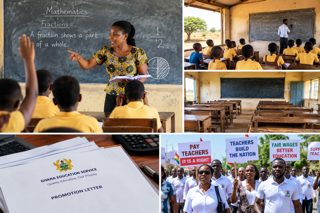
Ghana has finally invented something the world has never seen. Forget about Kantanka cars and local rice. We have invented Promotion Without Pay.
It is a brilliant economic model. The World Bank and IMF should send a delegation to the Ministry of Education, the Fair Wages and Salaries Commission, and the Controller and Accountant-General’s Department to come and learn how it is done.
Here is how it works. You gather over 100,000 teachers across the country. You tell them to pay money to register for a promotion examination. You make them travel to centres, buy past questions, attend workshops, and sleep with their books. Over 80,000 of them pass in December 2025 and February 2026. You clap for them. You print beautiful promotion letters with big Ghana Education Service logos. You change their titles from Principal Superintendent to Assistant Director II, Assistant Director I, Deputy Director. Very sweet titles. Titles are free, so you give plenty.
Then comes the small, insignificant part of the whole thing: paying them.
And that is where the masterclass begins.
Lesson 1: The Art of Validation
If you want to deny a teacher what he has legitimately worked for without appearing to deny him, you use one word: Validation.
Validation is a very powerful word in Ghana. It means we are checking. It means we are verifying. It means we have not said we will not pay, we are just checking whether you are you.
So after promoting 60,000 teachers on paper, you place only a little over 6,000 on the correct salary scale. You leave 54,000 people carrying promotion letters in their bags but old salaries in their pockets. When they ask why, you say their data is being validated. When GNAT asks, you say Controller is working on it. When Controller is asked, he says GES has not submitted all names. When GES is asked, they say FWSC has not given clearance.
It is a perfect circle. No one is responsible, yet everyone is involved. That is why we call it irresponsibility. It is not that one person is irresponsible; it is that responsibility itself has disappeared.
The teachers waited from January to September 2026. Nine months. A full pregnancy. They waited while prices of gari, fuel, and rent went up. They waited while their promotion letters gathered dust.
Finally, the unions – GNAT, NAGRAT and PRETAG – did what every Ghanaian worker must do to be paid: they threatened to strike. On September 22, they gave government up to midday September 24 to place all promoted teachers and pay arrears from January. Government did what government does best: it called a meeting.
The meeting did not produce money. So on September 25, the teachers closed the classrooms. From Limanyiri Vuori in Wa to the basic schools in Accra, the schools became empty. Pupils went home. Parents started calling radio stations.
Suddenly, government remembered that teachers exist.

Lesson 2: The Committee Economy
When government does not want to pay but wants to appear to be paying, it forms a committee.
And so on the directive of President John Dramani Mahama, a high-powered government team was formed. It included Education Minister Haruna Iddrisu, Finance Minister Dr. Cassiel Ato Forson, the Employment and Labour Relations Minister, the Controller and Accountant-General, and the FWSC. A very powerful team. Powerful enough to pay.
Minister Haruna Iddrisu, to give him credit, tried. He is a man who would rather be talking about STEM education, smart classrooms, and how to improve learning outcomes. Instead, he found himself every morning explaining why a teacher promoted in December 2025 is still earning the salary of November 2025 in October 2026.
You could see the frustration on his face. He held press conferences and gave assurances. “All placements will be honoured on or before October 30, 2026,” he said. “Arrears will be paid from January 2026. From Monday, Controller will start validation and supplementary payments will follow.“
But teachers in Ghana have PhDs in government promises. They have heard such assurances since 2015. So they replied with a new philosophy: No Alert, No Class.
They said, “Honourable Minister, we respect you, but we want bank alerts, not press releases.” And who can blame them? In this country, a promise can buy you nothing at Makola, but an alert, even GH¢80 alert, can buy you credit.
This is what brings to light how the Minister for Education was frustrated. He controls education policy, but he does not control the payroll. He can promise, but he cannot press the button at Controller. He is a driver of a car whose engine is in another man’s house.
Lesson 3: Pay Them Almost Nothing and Call It Arrears
Then came the most creative part of the whole masterclass. After the strike, government finally paid.
And what a payment it was!
Teachers who were expecting between GH¢3,000 and GH¢6,000 as arrears for nine months woke up to see MoMo alerts of GH¢350, GH¢180, GH¢80. Some got GH¢45. One teacher in the Upper West Region reported receiving GH¢22 as promotion arrears. GH¢22 for nine months. That is GH¢2.44 per month for being promoted. Even offering to the gods is more than that.
This is where the platform was fully used to deny teachers. You don’t tell them you won’t pay. You pay them almost nothing. Then on paper, you can say, “We have paid promotion arrears.” Technically, you have. Legally, you have. Morally, you have robbed them.
How do you calculate GH¢80 as nine-month arrears for a salary difference that should be at least GH¢300 per month? Only the validation machine knows.
Many teachers got almost nothing. And that almost nothing is actually a clear message: Your promotion is not important. Your nine months of waiting is not important. Your work in that deprived village is not important.
It is a clear denial of what is owed to teachers and a clear sign of irresponsibility on the part of government.
Lesson 4: Let Everything Else Expire Too
To make the masterclass complete, you must not only mess up promotion arrears. You must let everything else expire.
The Collective Agreement that governs teachers’ conditions of service expired. GNAT says it submitted proposals for a new agreement in August 2025. The Fair Wages and Salaries Commission was supposed to finish negotiations by June 2026. It did not. We are now in late 2026 with no Collective Agreement. How do you run an education system with over 300,000 teachers without a Collective Agreement? You run it with meetings and promises.
Then there is the famous 20% Deprived Area Allowance. This is money meant for teachers who agree to go to places where even the network does not want to go. Places without light, without water, without accommodation. In the 2024 Collective Agreement, it was promised. President Mahama directed that it should be implemented. A year later, the Ministry of Education and GES say they are still reviewing the report that lists which areas are deprived.
They are still reviewing! Perhaps they sent officers to check if the deprived areas have become developed, so they can remove them from the list and save money. Perhaps they are waiting for all teachers to leave those villages so there will be no one to pay.
Meanwhile, the Nkwanta South District has 457 vacancies because teachers refuse to stay due to chieftaincy conflicts and lack of incentives. Who will teach those children?
The Final Lesson: Teach Responsibility by Being Irresponsible
Every morning in Ghana, a teacher wakes up at 5 a.m., sweeps his single room, bathes with cold water, and walks two kilometres to a school where the blackboard is broken. He teaches 60 children to be responsible, to be punctual, to work hard and expect reward.
Then government teaches those same children a different lesson through how it treats the teacher: that you can work hard, pass an exam, be promoted, and still be paid GH¢80 after nine months. That responsibility is for pupils, not for the state.
That is the greatest irresponsibility.
So to all young SHS graduates reading this, here is free advice: If you want to be celebrated, become a teacher. Ghana will celebrate you on Teachers’ Day. They will give you a toffee and a certificate. If you want to be paid, become something else.
And to the government, we must say thank you. Thank you for teaching us that promotion is not about money, it is about title. That arrears is not about what you are owed, it is about what you are given. That teaching is not a profession, it is a sacrifice, and you must sacrifice until there is nothing left.
The 2025 promotion will be remembered in the history of Ghana Education Service not as the year teachers were promoted, but as the year they were promoted and paid almost nothing after a strike, while the Minister for Education watched in frustration.
It is indeed a masterclass. And we have all graduated with distinction.
 Ishmael Junourgh